
Top School Furniture Manufacturers in China
Compare Chinese school furniture manufacturers and exporters by product range, project support, quality evidence, production capability, and global delivery readiness.
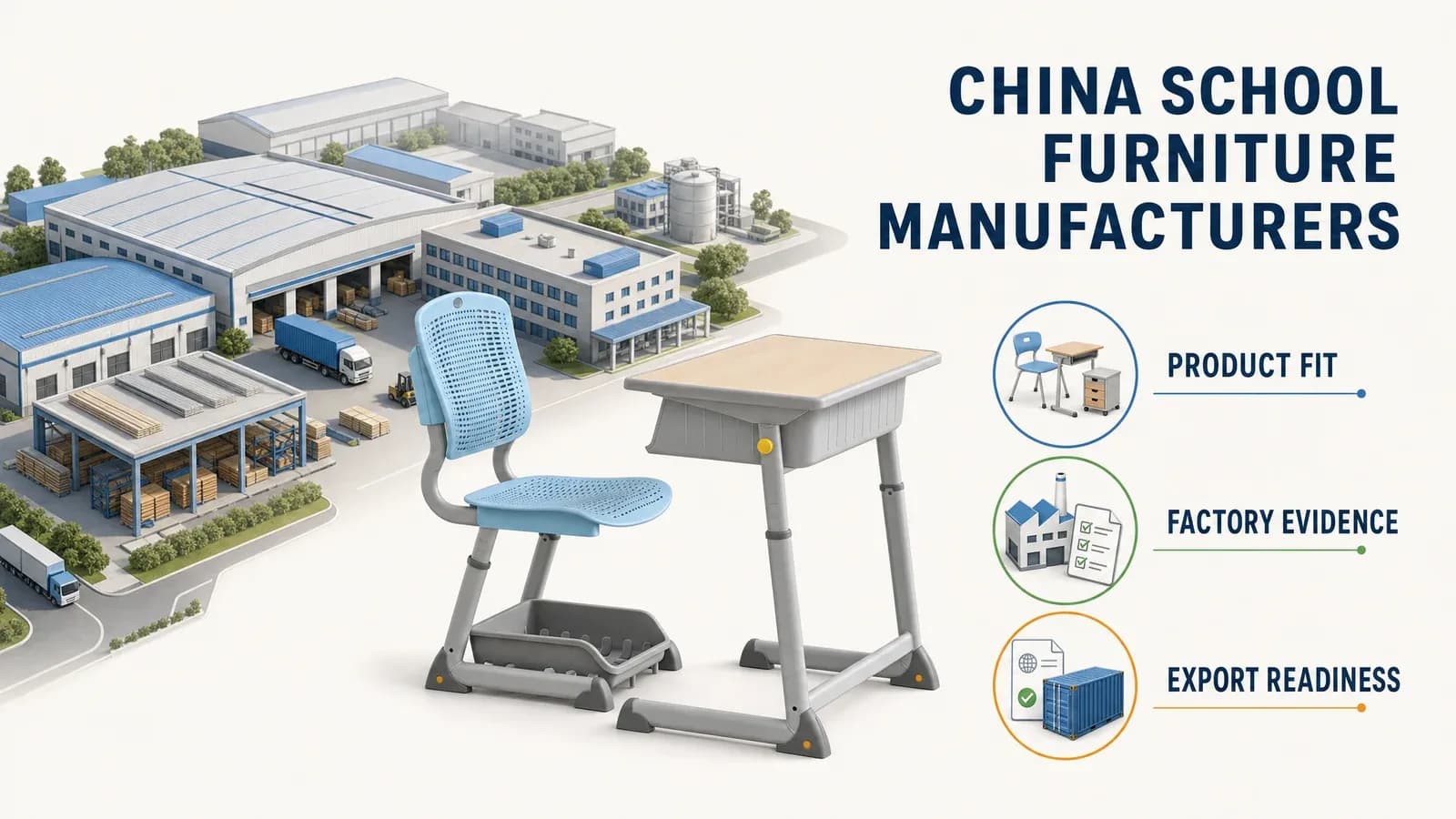
Table of Contents
Global buyers comparing top school furniture manufacturers in China need a shortlist they can verify, not a list built from marketing labels. The useful comparison covers product range, project fit, quality evidence, production records, export experience, and quotation support. This guide compares common manufacturer profiles, explains how to review Chinese school furniture exporters, and shows what to confirm before a school project moves to RFQ and samples.
Why Global Buyers Consider Chinese School Furniture Manufacturers
China has a broad school-furniture manufacturing base serving classrooms, dormitories, libraries, laboratories, cafeterias, and flexible learning spaces. That breadth gives international buyers more routes to source desks, chairs, storage, beds, tables, and coordinated campus packages from one market.
The value of a Chinese manufacturer depends on the fit between the factory's product system and the project. A classroom desk-and-chair order needs different evidence from a multi-building campus package. A standardized program may prioritize repeatable configurations and batch control. A design-led project may need more work on layout, samples, finishes, and room coordination.
Customization is another reason buyers include Chinese school furniture exporters in a global search. OEM and ODM suppliers may support controlled design changes, while other manufacturers focus on established product families. Buyers can compare these routes through drawings, samples, bills of materials, approved finishes, and documented change control.
Price remains part of the commercial discussion, yet it works only when the quoted scope is clear. Product configuration, packaging, shipping responsibilities, destination requirements, and project services can change the total value of an offer. A comparable RFQ gives buyers a better basis for judging the result.
What Makes a School Furniture Manufacturer Worth Shortlisting?
A manufacturer earns a place on a project shortlist when its evidence matches the buyer's actual requirements. Review the following dimensions together:
| Comparison area | Questions for the buyer |
|---|---|
| Product coverage | Can the supplier provide the required desks, chairs, storage, beds, tables, or specialist furniture? |
| Project fit | Does the range suit the users, rooms, activities, quantities, and destination market? |
| Quality evidence | Are samples, drawings, material records, inspection points, and relevant reports tied to the quoted configuration? |
| Production capability | Can the supplier explain its production role, key processes, current workload, and batch-control method? |
| Export readiness | Can it define packaging, shipping documents, trade-term assumptions, and the responsibilities of each party? |
| Project support | Can the team work from a room schedule, coordinate changes, and prepare a quotation that shows exclusions? |
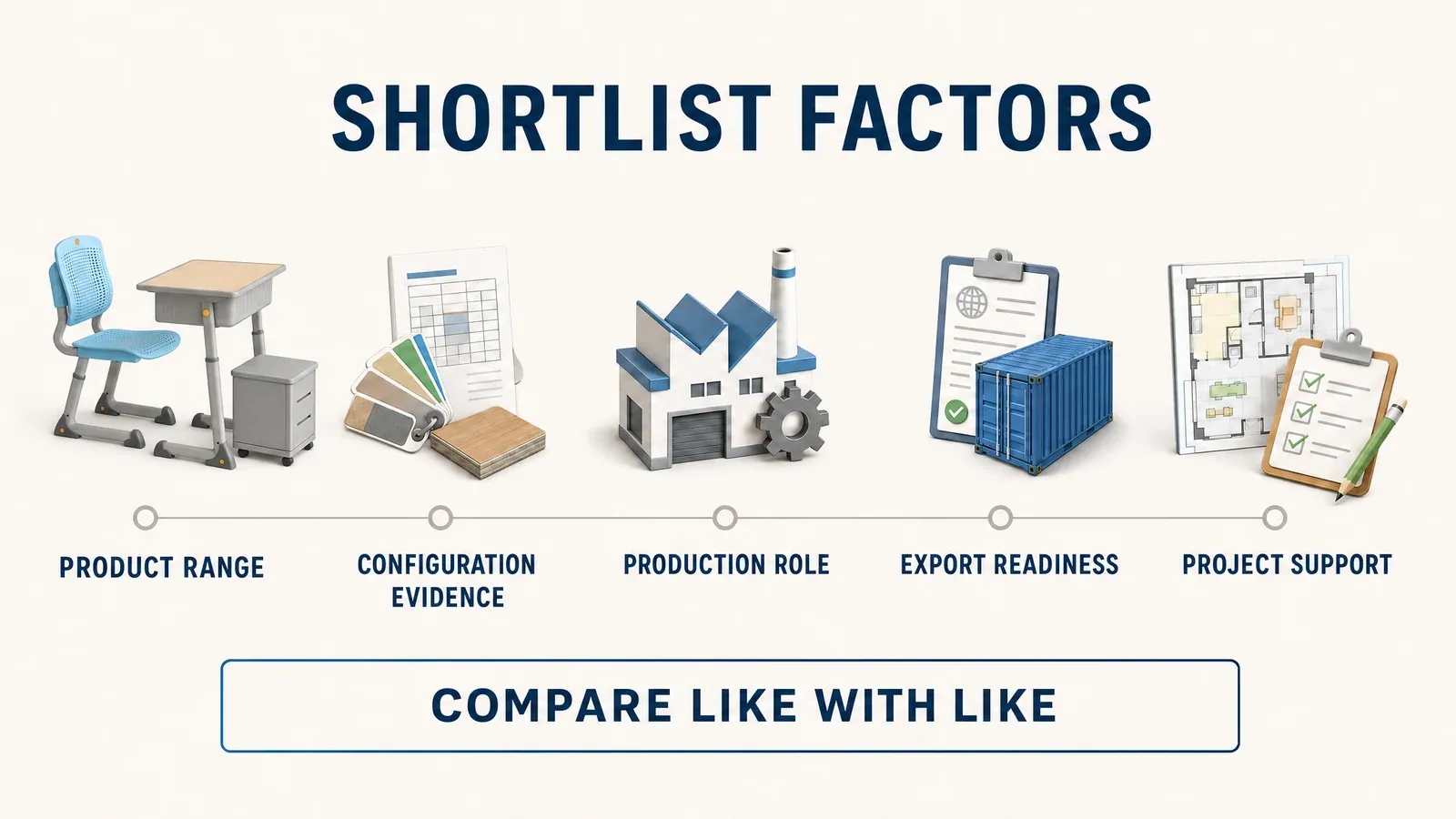
Company size alone does not answer these questions. A large catalog may contain products outside the factory's current scope. A small specialist may be a better fit for a focused classroom program. Ask for evidence attached to the model, configuration, quantity, and destination rather than relying on a general company description.
The same rule applies to quality and sustainability language. Terms such as durable, ergonomic, green, or export-ready become useful when the supplier explains the material, structure, test document, production control, or market file behind them. The buyer can then decide which points need a sample, a document review, or an inspection.
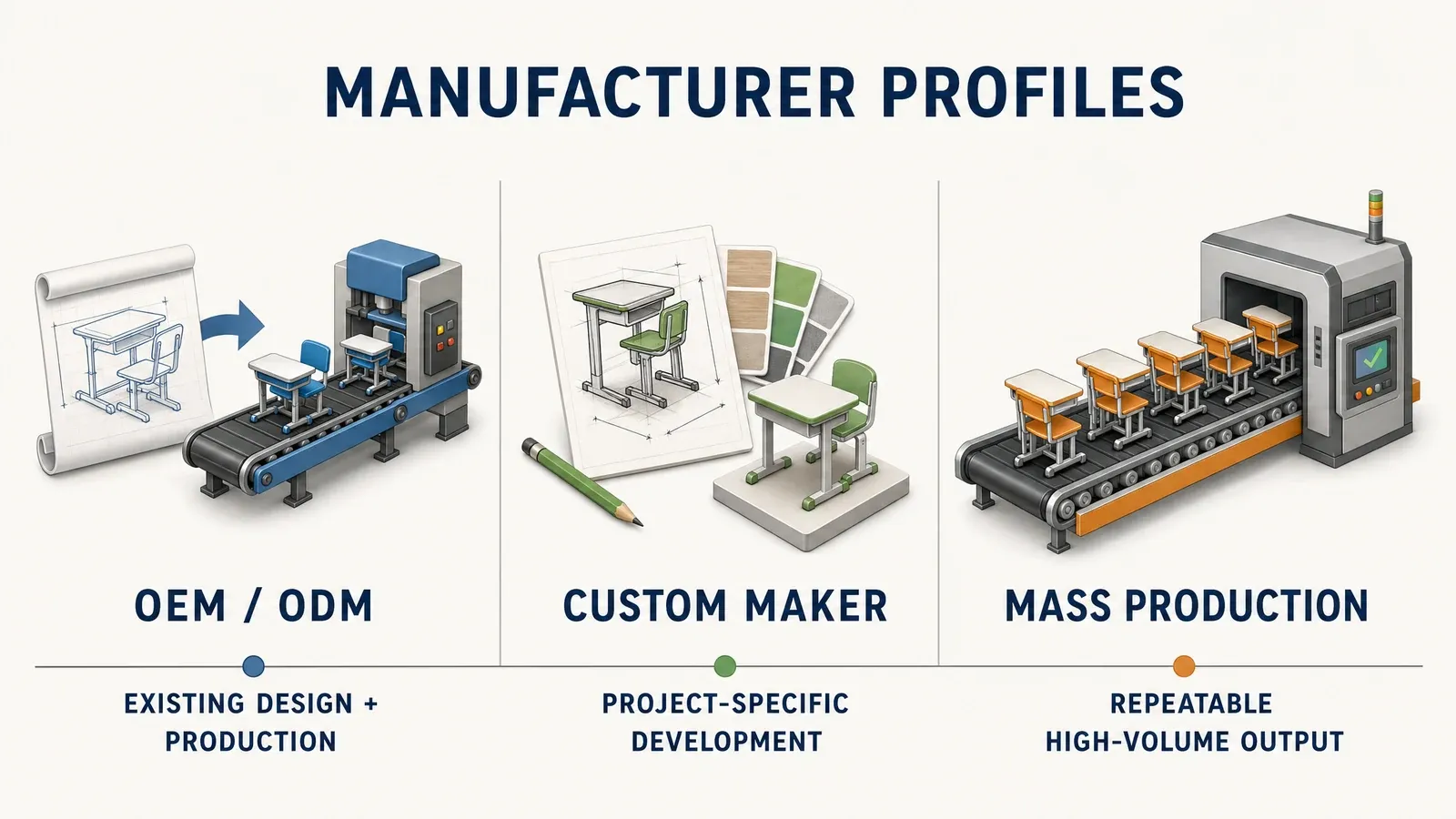
Three Manufacturer Profiles Global Buyers Should Compare
OEM and ODM Manufacturers
OEM and ODM manufacturers suit projects that need controlled changes to an established product or a buyer-owned design. The buyer should clarify who owns the drawing, which elements can change, how the BOM is approved, and how the factory controls revisions during production.
This profile can work well for distributors with a defined product identity, education contractors coordinating several markets, or projects that need a particular desk, chair, storage unit, or classroom layout. The comparison should focus on design control, sample approval, tooling or component responsibility, and the evidence attached to the final configuration.
Custom Furniture Makers
Custom furniture makers are useful when a school project includes coordinated spaces, unusual room dimensions, or a combination of furniture types. Their value comes from translating a room plan into products, finishes, circulation needs, and installation-ready information.
The buyer should set a clear customization boundary. Ask which dimensions, colors, accessories, materials, and structures are available, and which changes require a new drawing or sample. A project plan should also show how custom items remain consistent across buildings and delivery batches.
Mass-Production Factories
Mass-production factories suit standardized programs with clear models, predictable quantities, and planned delivery batches. Their evaluation centers on equipment, process flow, incoming-material checks, production inspection, packing capacity, and the current order schedule.
The key question is how the factory will protect the approved product while producing the required quantity. Review the sample baseline, inspection records, carton markings, spare-parts plan, and loading schedule. A high annual figure has limited value without a product mix, measurement basis, and order-specific plan.
How to Compare Chinese School Furniture Exporters
Start the comparison with the spaces in your project. Classroom desks and chairs may be the core purchase, while lockers, dormitory beds, library furniture, laboratory workstations, cafeteria tables, teacher furniture, and seating complete the campus. A supplier's product range should be mapped to the room list rather than described as a general catalog.
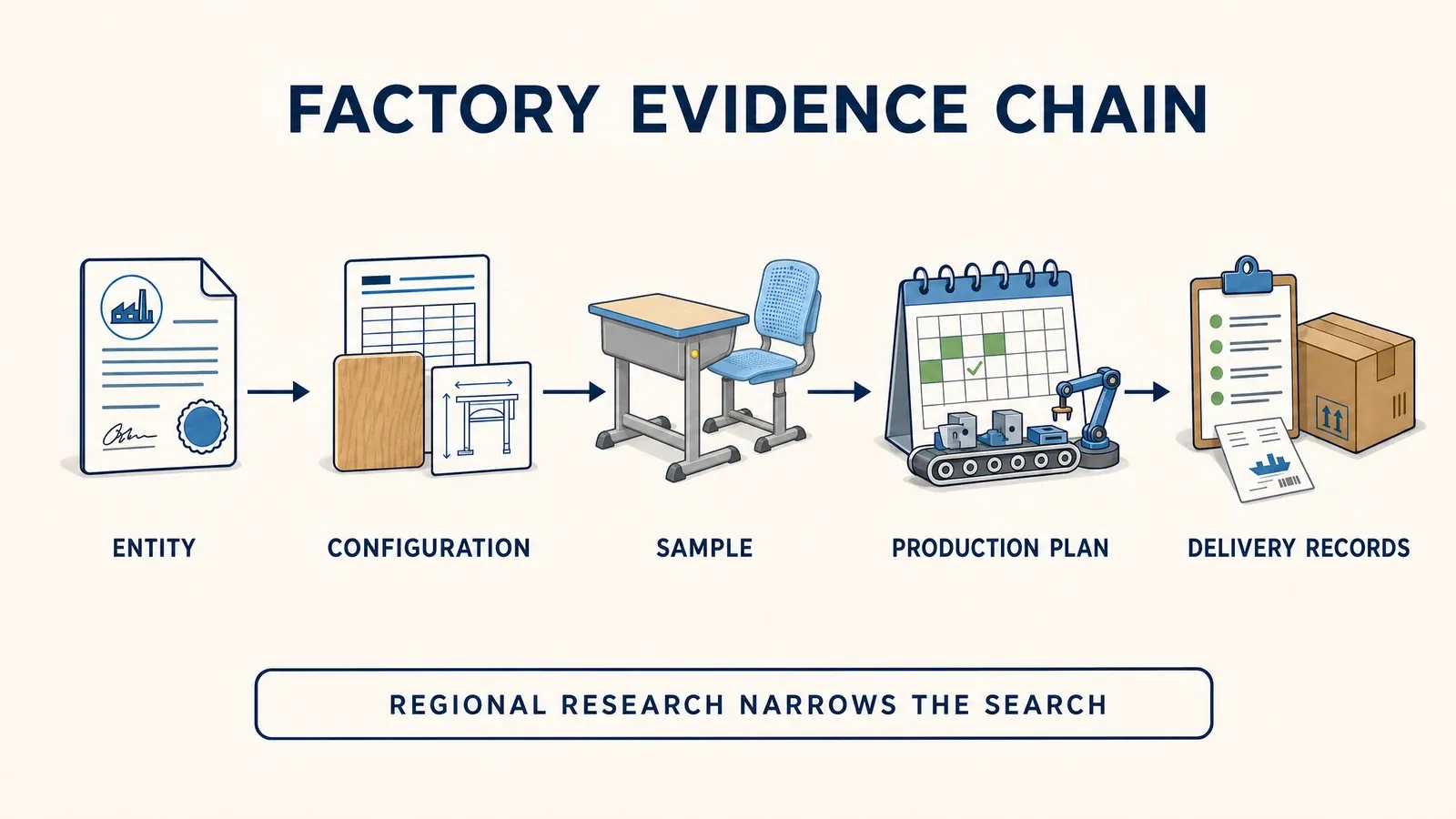
Regional research can help narrow the first search. Our guide to China school furniture manufacturing hubs explains how product specialization, materials, processing, and logistics differ between manufacturing areas. That regional view creates a useful starting point; the factory's samples and records determine whether the shortlist is practical.
For each exporter, compare the following:
- The exact categories and models offered for your rooms.
- The users, dimensions, materials, structures, finishes, and accessories covered by each model.
- The factory's role: direct manufacturer, group company, trading company, or coordinated supply network.
- The sample, drawing, BOM, test report, certification, and inspection evidence linked to the quoted configuration.
- The ability to separate product price, packaging, inland transport, shipping, installation, spare parts, and other services.
- The destination-market documents and responsibility assignments needed for your project.
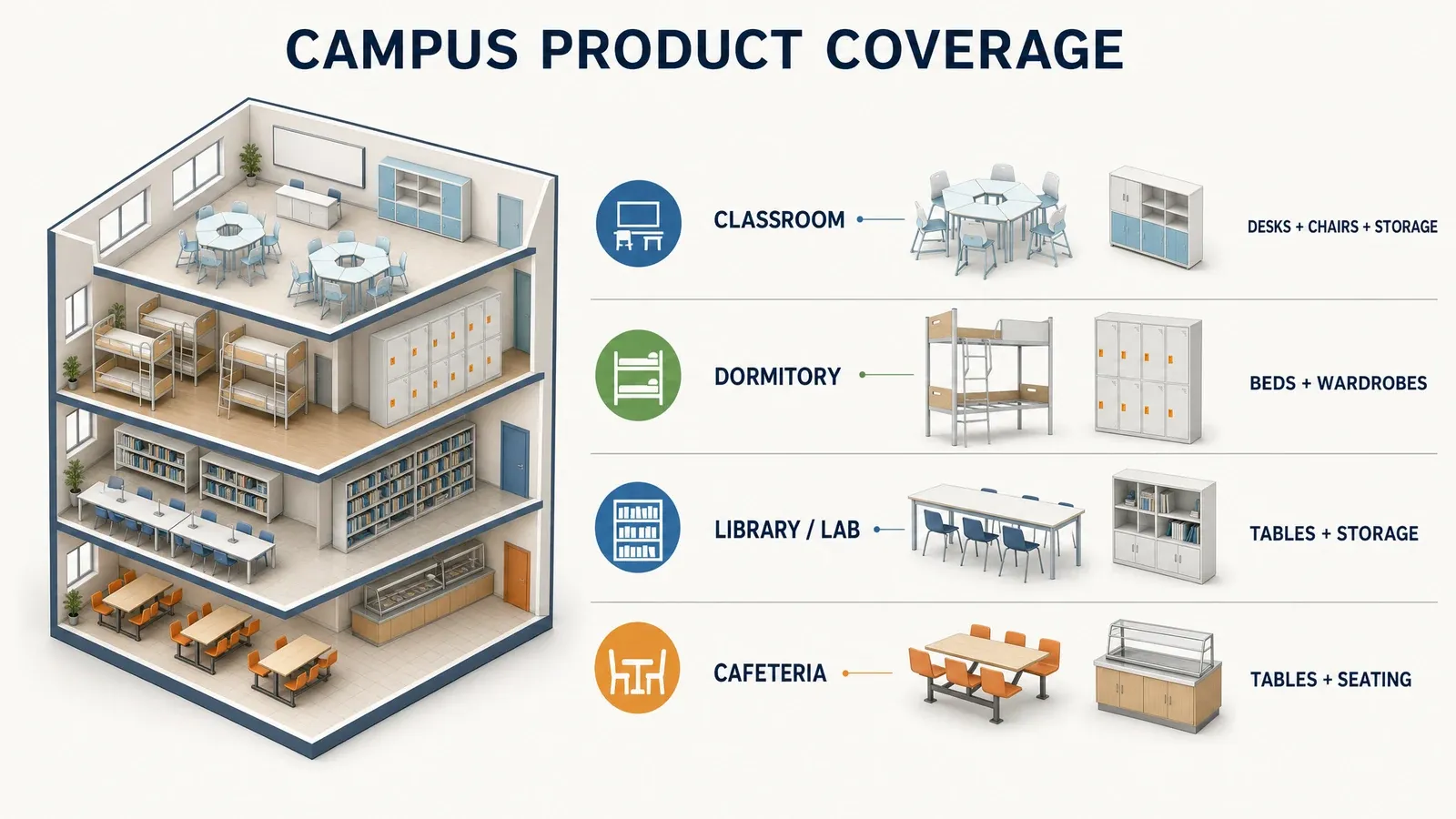
This structure makes an exporter comparison more useful than a simple ranking. It also helps buyers decide whether one supplier can coordinate a complete campus order or whether specialist suppliers should cover separate categories.
Yuzhen Furniture: A China School Furniture Exporter for Global Projects
Yuzhen Furniture was founded in 1991. Its recorded production-base information lists a 13,200 m² Zengcheng production base and a 26,000 m² Zengcheng flexible production base, totaling 39,200 m². The current company-level annual production record is 250,000 sets. This is a company-level figure; product mix and order-specific capacity still need to be confirmed for each project.
Yuzhen Furniture focuses on campus furniture for classroom, nap, dormitory, storage, seating, and modular classroom use. That scope gives a buyer a starting point for reviewing whether the available categories match the project brief. The model, material, configuration, sample, and commercial terms remain project-specific.
The owner-confirmed exporter profile records school furniture exports to 132 countries and regions. It also records school desks, chairs, and other school furniture supplied to education departments in more than 30 countries. The named project profile includes Saudi Arabia, Kuwait, Egypt, Ghana, Israel, Zambia, Mozambique, the Dominican Republic, Nigeria, Kenya, and Oman. These records describe company export and project experience; they do not define a universal product range, current order status, or government qualification for every market.
For project inquiries, Yuzhen Furniture can support layout design, functional planning, customized school desks and chairs, and quotation cooperation. Current sales guidance treats customization as product- and order-specific, with color and selected accessories considered through project confirmation. Buyers can connect this support to a room schedule, quantity list, target market, budget context, schedule, and logistics background.
The next step is to match the proposed models and documents to the actual project. A company profile helps a buyer decide whether to open a conversation; drawings, samples, configuration records, and the final quotation determine the working scope.
What to Verify Before Choosing a Manufacturer
Before awarding a school furniture order, ask the shortlisted supplier to provide evidence in the same sequence:
- Legal and supply role: Confirm the contracting entity, production site, factory role, and the party responsible for each outsourced process.
- Product and configuration: Record model numbers, dimensions, materials, structures, finishes, accessories, packaging, and revision status.
- Sample control: Approve a sample or drawing that represents the production configuration. Record changes before mass production.
- Quality records: Match test reports, certificates, material declarations, inspection points, and labels to the product, market, and model in the quotation.
- Production plan: Ask how the supplier will manage materials, process checks, current workload, batch identity, and final inspection.
- Packaging and delivery: Confirm carton marks, packing lists, loading assumptions, shipping documents, delivery points, unloading, installation, and damage reporting.
- Destination requirements: Identify which party will check customs, product information, safety documents, and any market-specific requirements.
The school furniture supplier evaluation guide provides a broader procurement framework for turning these questions into a supplier review. Use the same written scope for every candidate, then record unanswered items as open actions rather than treating a polished catalog as proof.
How to Prepare a Comparable School Furniture RFQ
A useful RFQ lets each supplier price the same project. Include:
- Buyer role, organization, project stage, and decision timetable.
- Target country, delivery point, port or logistics assumptions, and any local responsibilities already assigned.
- Room schedule covering classrooms, dormitories, libraries, laboratories, cafeterias, offices, or other spaces.
- Product categories, quantities, users, dimensions, materials, finishes, accessories, and configuration requirements.
- Drawings, reference images, sample expectations, BOM fields, labels, packaging, assembly, and spare-parts requirements.
- Quality documents, destination-market files, inspection points, and approval gates.
- Requested quotation format, payment assumptions, delivery milestones, exclusions, and optional items.
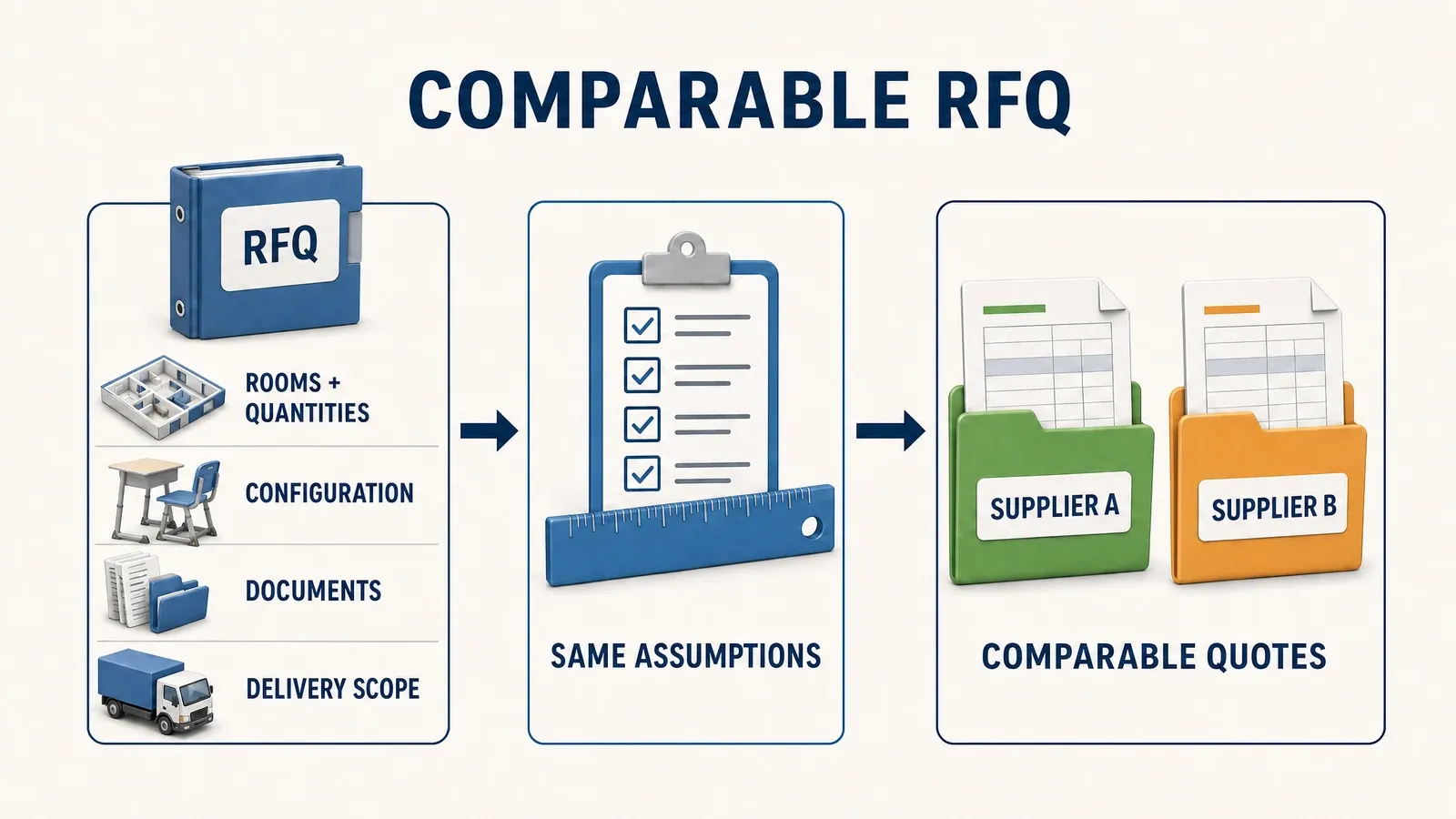
Ask the supplier to identify the products it will manufacture directly, the processes it will coordinate, and the documents it can provide for the quoted configuration. This makes it easier to compare an OEM/ODM offer with a standard mass-production offer or a coordinated campus package.
Yuzhen Furniture's inquiry process asks buyers to provide their role, project or tender status, product category, quantity, budget, target market, schedule, and logistics context. Contact Yuzhen Furniture with those inputs when you are ready to compare a product list, project scope, or quotation path.
Frequently Asked Questions
How do I find school furniture manufacturers in China?
Start with manufacturer websites, product pages, regional sourcing research, trade-show contacts, and relevant B2B directories. Build a shortlist around your product categories and project requirements, then verify the legal entity, production role, samples, quality documents, current workload, packaging, and destination-market responsibilities.
What should I compare when choosing a Chinese school furniture exporter?
Compare the product range, intended users and spaces, customization boundary, sample and BOM control, quality evidence, production records, export documents, project communication, packaging, and delivery responsibilities. Keep the same written scope for every supplier so the quotations can be compared.
Can one manufacturer supply a complete school furniture project?
Some manufacturers can coordinate several campus-furniture categories, while the actual scope depends on the supplier's documented product range, configuration, production plan, and project responsibilities. Ask the supplier to map each room, product category, model, quantity, sample, document, and delivery step before treating a proposal as a complete solution.
What information should I include in an RFQ for a Chinese school furniture manufacturer?
Include the buyer role, project stage, rooms and users, product categories, quantities, target market, budget context, schedule, delivery point, configuration, finish, packaging, sample requirements, quality documents, and logistics assumptions. Ask every supplier to identify exclusions and responsibilities in the same format.
Planning a global school furniture project? Contact Yuzhen Furniture with your product categories, quantities, target market, schedule, and logistics background.