
China School Furniture Manufacturing Hubs: A Regional Comparison for Buyers
Compare six school furniture manufacturing hubs in China, match regional strengths to school furniture projects, verify individual factories, and prepare a comparable RFQ.
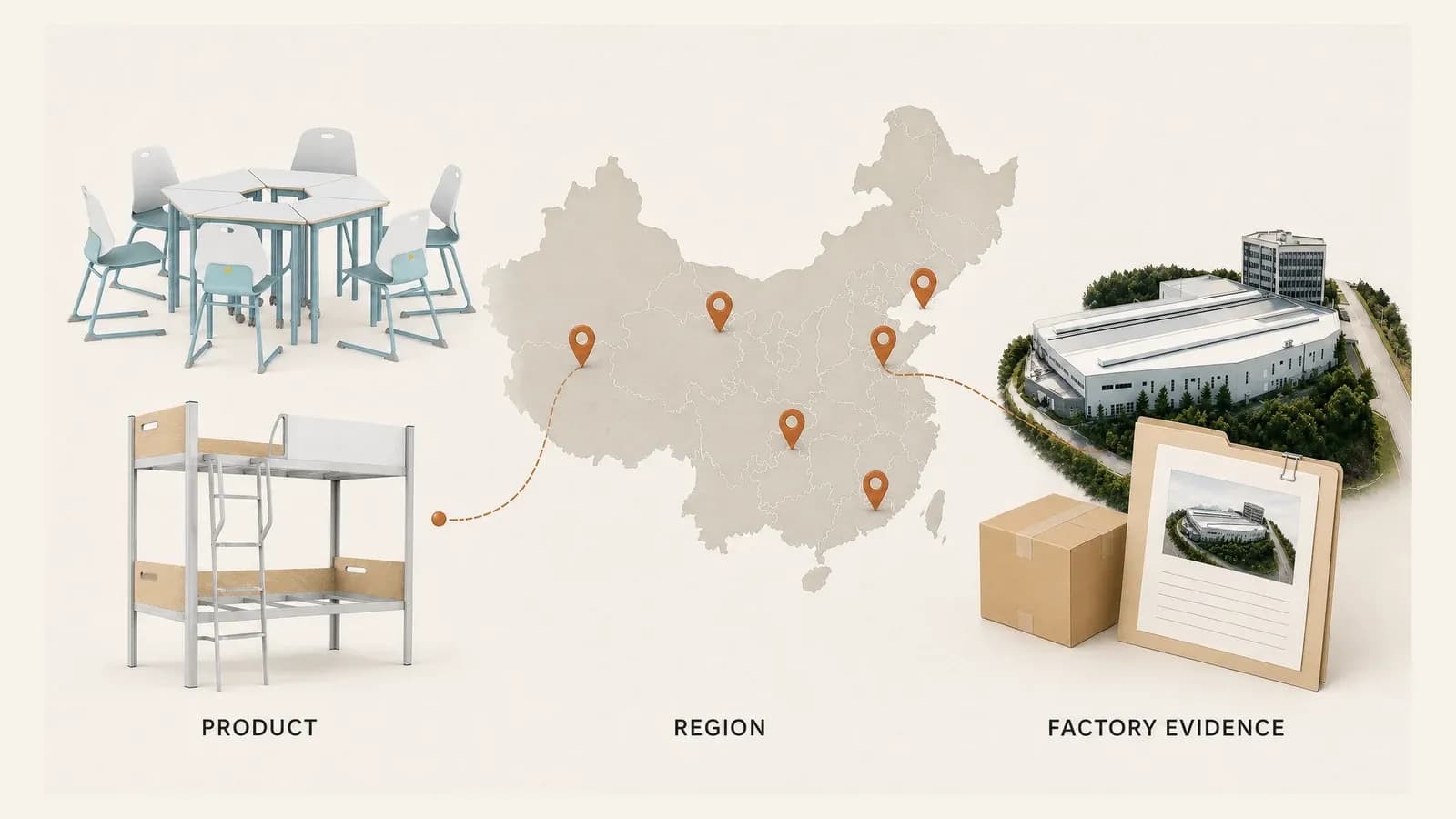
Table of Contents
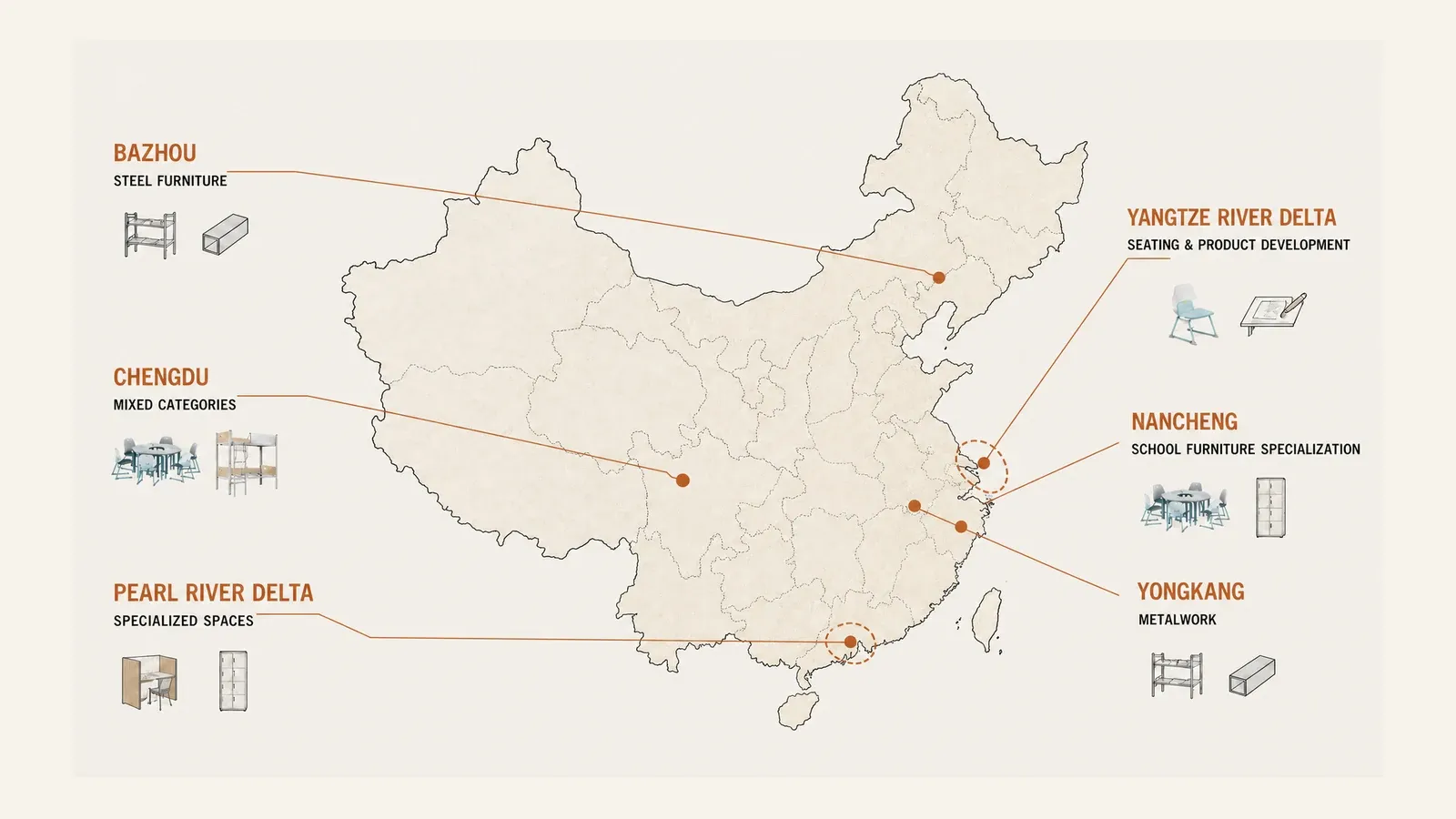
China's furniture manufacturing hubs serve different school furniture projects. Nancheng concentrates school furniture production. Yongkang and Bazhou connect buyers with metalworking and steel furniture. Chengdu serves mixed educational furniture in western China. The Pearl River Delta supports specialized campus spaces and export projects. The Yangtze River Delta is strong in seating and product development. Buyers can shortlist by project fit, then verify the individual factory through production evidence and a consistent RFQ.
1. China Furniture Manufacturing Regions and Industry Clusters
China's furniture industry generates more than RMB 800 billion in annual output, and the country has ranked first globally in furniture exports for consecutive years. The industry sources supplied for this article place approximately 90% of national furniture production capacity within five major clusters. They are the Pearl River Delta, Yangtze River Delta, Bohai Rim, Northeast China, and Western China.
These furniture manufacturing regions grew around different materials, processes, labor pools, markets, and transport networks. An established cluster brings factories closer to component suppliers, tooling, specialist machinery, finishing services, packaging, quality-control resources, and logistics. That ecosystem explains why product categories often concentrate in particular cities or provinces.
The Pearl River Delta and Yangtze River Delta are China's largest furniture production and export regions. The Bohai Rim connects northern buyers with metal and steel-wood furniture. Northeast China developed around timber and solid-wood processing. Western China, led by centers such as Chengdu, serves inland markets through regional manufacturing and logistics networks.
| Industry indicator | Reported figure | Scope |
|---|---|---|
| China's annual furniture output | More than RMB 800 billion | Whole furniture industry |
| Capacity concentrated in five major clusters | About 90% | National furniture manufacturing capacity |
| Pearl River Delta furniture output | About one-third of national output | Regional furniture-industry share |
| Yangtze River Delta furniture output | About one-third of national output | Regional furniture-industry share |
| Guangdong furniture enterprises and employment | 8,000+ enterprises; 1 million+ workers | Conventional enterprise and workforce figures |
| Guangdong active furniture-related factories | 32,000+ | Separate active-production database; about one-third of registered active furniture factories nationwide |
| Zhejiang furniture enterprises and employment | 3,000+ enterprises; 500,000+ workers | Conventional enterprise and workforce figures |
The two Guangdong factory counts come from separate datasets. The conventional industry count covers 8,000+ furniture enterprises and more than one million workers. A production database reports 32,000+ active furniture-related factories and covers approximately 4.8 million active factories across all sectors. Keeping these datasets separate preserves their original definitions.
For school furniture buyers, this industrial map identifies where relevant suppliers, materials, and supporting processes are concentrated. The next step is a product-focused comparison of six manufacturing hubs.
2. Six School Furniture Manufacturing Hubs in China
The five clusters describe China's broad industrial geography. School furniture sourcing becomes more practical at the city and subregional level, where product specialization and supporting processes are easier to compare.
| Manufacturing area | Main industrial strength | Relevant school furniture | Typical project fit |
|---|---|---|---|
| Jiangxi Nancheng | Specialized school furniture manufacturing | Student desks and chairs, dormitory beds, library shelving | K-12 schools and multi-category campus projects |
| Zhejiang Yongkang | Hardware and metal processing | Steel desks and chairs, metal bunk beds, lockers, auditorium seating | Metal-intensive products and scalable OEM production |
| Hebei Bazhou | Steel, tubing, and steel-wood furniture | Steel-wood desks and chairs, cafeteria furniture, dormitory beds | Standard products and larger-volume orders |
| Sichuan Chengdu | Comprehensive furniture and educational equipment | Teaching furniture, laboratory furniture, wooden and panel dormitory products | Western China projects and mixed product categories |
| Pearl River Delta | Commercial furniture and export-oriented manufacturing | Auditorium seating, laboratory cabinets, library and specialized-space furniture | Universities, international schools, and customized projects |
| Yangtze River Delta | Seating, product development, and modern furniture manufacturing | Ergonomic seating, teacher chairs, adjustable desks, modular classroom furniture | Flexible classrooms and design-led projects |
2.1 Jiangxi Nancheng: School Furniture Specialization
Nancheng is an important school furniture manufacturing base. The supplied industry research estimates that the area accounts for approximately 30%-35% of China's school furniture market. Established categories include wooden and steel-wood student desks and chairs, dormitory beds, and library shelving.
Its main advantage is a local network built around school furniture. Material purchasing, design, production, and transportation can be coordinated within the same industrial base. That combination supports cost control and multi-category K-12 projects covering classrooms, dormitories, and libraries.
Nancheng traditionally serves domestic school procurement and continues to expand its export activity. Some manufacturers are also developing technology-oriented furniture, including AI-enabled desk concepts. A smart-desk RFQ needs a precise list of functions, electronic components, software dependencies, safety documents, maintenance requirements, and after-sales responsibilities for the quoted model.
2.2 Zhejiang Yongkang: Metal Processing and Hardware
Yongkang is a major hardware and metalworking center. Its supply base suits school furniture built around steel frames and precision metal parts, including student desks and chairs, bunk beds, lockers, and auditorium seating.
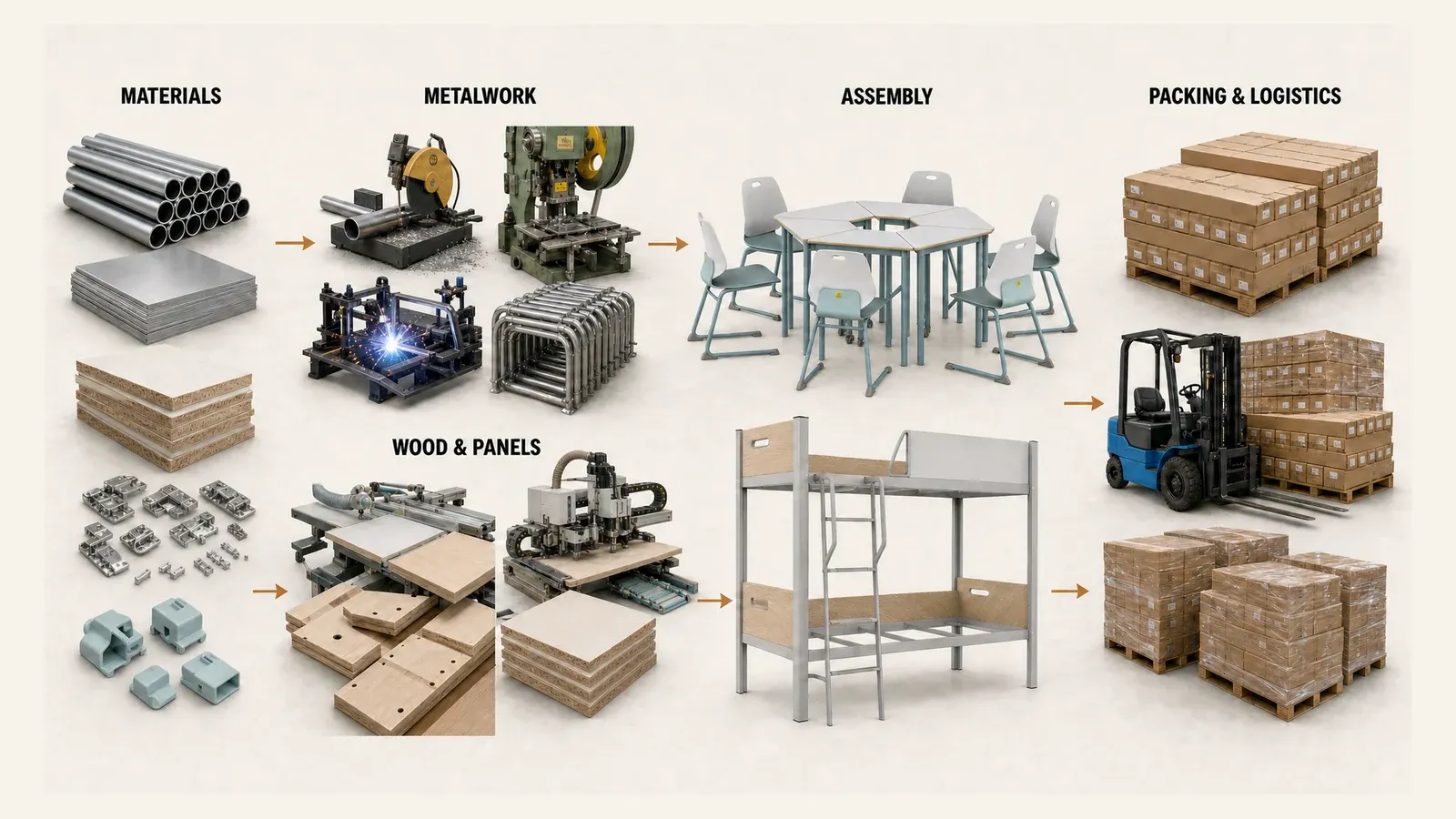
The local process network covers stamping, tube forming, welding, spraying and powder coating, tooling, and mold development. These resources help factories refine structural components, prepare repeatable tooling, and scale established models for tenders or OEM orders.
Translate that regional strength into a product specification. Record the steel grade and thickness, tube dimensions, joint design, weld acceptance, surface pretreatment, coating system, hardware, structural requirements, and finished-product tests. The approved sample and quotation then share one measurable metalwork standard.
2.3 Hebei Bazhou: Steel-Based Furniture and Northern Distribution
Bazhou developed around steel, tubing, plastic components, and steel-wood furniture. Relevant products include steel-plastic and steel-wood desks and chairs, cafeteria tables and seating, and metal dormitory beds.
Proximity to Beijing, Tianjin, northern consumer markets, and steel-producing areas supports bulk production and domestic distribution. The regional network reaches northern, northeastern, and northwestern China with shorter inland routes.
For an export order, calculate route economics from the packed product. Compare carton dimensions, container utilization, inland transport to the selected port, consolidation options, export experience, and responsibility at each delivery stage. These inputs turn Bazhou's domestic location advantage into a project-specific logistics decision.
2.4 Sichuan Chengdu: Educational Furniture in Western China
Chengdu is a comprehensive furniture and educational-equipment center in western China. Its manufacturing base includes teaching furniture, laboratory equipment, solid-wood products, and panel-based dormitory furniture.
The wider western cluster benefits from industrial parks, local policy support, inland logistics, and production transferred from coastal regions. The supplied research also records factory expansion over the previous three years and a shift by some producers from contract manufacturing toward their own brands and online sales.
Chengdu fits western China projects that value regional customization, delivery, and service. For overseas projects, include export documents, packaging, port route, inland transit, and shipment schedule in the same comparison as the product range. This produces a complete view of the supplier's project fit.
2.5 Pearl River Delta: Specialized Spaces and Export Supply Chains
The Pearl River Delta includes Guangzhou, Shenzhen, Dongguan, Shunde, Foshan, and nearby manufacturing areas. The supplied research attributes approximately one-third of China's furniture output to this region, with a substantial share of exports serving the Americas.
Its school-furniture relevance is strongest in auditorium and lecture-hall seating, laboratory cabinets, library furniture, upholstered reading areas, and customized commercial learning spaces. Supporting industries cover hardware, panels, fabrics, upholstery, surface finishing, product development, trading, and export logistics.
The local centers play different roles. Shunde combines manufacturing, sales, materials, and wholesale resources. Lecong is a major distribution and showroom center, while Longjiang concentrates furniture production and supporting materials. Dongguan Houjie is associated with solid-wood and export furniture. Shenzhen adds upholstered, office-furniture, engineering, and product-development resources.
This breadth suits universities, international schools, private schools, and campuses with several specialized spaces. Match every environmental or safety document to its issuing organization, certificate holder, product model, configuration, validity period, and destination-market requirement. The result is a document set tied to the quoted products.
2.6 Yangtze River Delta: Seating and Product Development
The Yangtze River Delta covers Zhejiang, Jiangsu, Shanghai, and connected manufacturing areas. It combines developed transport infrastructure, skilled labor, manufacturing resources, and strong domestic and export markets. The supplied research attributes approximately one-third of national furniture output to the region, with Europe and the United States among its major export markets.
Zhejiang shows the region's range. Hangzhou is associated with office furniture, Anji with chair manufacturing, Huzhou with traditional wood furniture, Haining with export sofas, and Jiashan with export solid-wood furniture.
For school furniture, the strongest connections are ergonomic seating, teacher chairs, adjustable desks, nap desks, and modular furniture for flexible classrooms. Seating components, product development, and prototype resources support projects that extend beyond standard fixed-size desks and chairs.
The supplied industry sample reports a relatively high export-order share for Zhejiang factories and an average export order value approximately 18% above comparable Guangdong factories. The figure describes that regional sample. Use it as export-activity context, then compare design capability, prototype control, sample quality, materials, batch controls, and export scope factory by factory.
3. Which China School Furniture Hub Fits Your Project?
Start with the campus spaces, product list, materials, processes, customization level, order scale, and delivery plan. These requirements reveal which regional supply chain deserves the first factory search.
3.1 Match the Region to the Product Category
For standard classroom desks and chairs, dormitory beds, and lockers, begin with Nancheng, Yongkang, and Bazhou. Nancheng offers a specialized school-furniture network. Yongkang and Bazhou provide deeper connections to metal processing and steel-based products.
For auditorium seating, laboratory cabinets, library furniture, and customized learning spaces, the Pearl River Delta offers a broader commercial-furniture supply chain and export ecosystem.
For ergonomic seating, adjustable desks, teacher chairs, nap desks, or modular classroom furniture, examine the Yangtze River Delta's seating and product-development resources.
Chengdu is a practical candidate for western China projects and mixed educational-furniture packages supported by regional production and service.
Use these matches to build the first shortlist. A complete school-furniture product may combine steel, panels, plastics, upholstery, electronics, and outsourced components. Map that bill of materials to the factory's actual processes before requesting a final offer.
3.2 Compare Materials and Manufacturing Processes
Metal desks, chairs, and bunk beds depend on tube specifications, frame design, cutting, forming, welding, surface pretreatment, coating, hardware, and assembly control. Wooden and panel furniture requires clear board or timber specifications, moisture and emission requirements where applicable, edge treatment, joints, finishes, and packaging protection.
Mixed-material products add another decision: which components are made at the quoted site, and which come from sub-suppliers? Record incoming-material checks, released specifications, component traceability, and inspection stages. The cluster accelerates access to materials and processes; the selected factory controls how they become a consistent finished product.
3.3 Match Customization to Order Scale
Large standard orders reward stable tooling, repeatable lines, and efficient batch planning. Projects with many room types, colors, sizes, or mechanisms place more weight on drawings, prototypes, revision control, and flexible scheduling.
Compare minimum order quantities by model and finish, tooling arrangements, sample charges, drawing approvals, color references, change deadlines, batch capacity, and production windows. Send the same written product brief to every shortlisted factory so each quotation covers the same configuration.
3.4 Calculate Export and Logistics Requirements
Manufacturing location affects inland transport, port access, supplier communication, and consolidation. Total delivered cost combines packed volume, container utilization, loading method, shipping route, destination services, and the Incoterm with its named place.
A campus package may source classrooms, dormitories, laboratories, and auditoriums from more than one region. Define who consolidates products, controls packaging and loading, manages each transport stage, and coordinates production batches with the site schedule. The best-fit hub provides a workable combination of product capability, production capacity, and delivery planning for the complete project.
4. How to Evaluate a School Furniture Manufacturer in China
Once the regional shortlist is ready, evaluate the actual production and delivery system behind each quotation. In the supplied research institute's factory-visit sample, buyers who relied on production landmarks and factory scale recorded an arrival-delay rate about 30% higher than systematically screened buyers. That sample supports a practical rule: pair regional reputation with order-specific factory evidence.
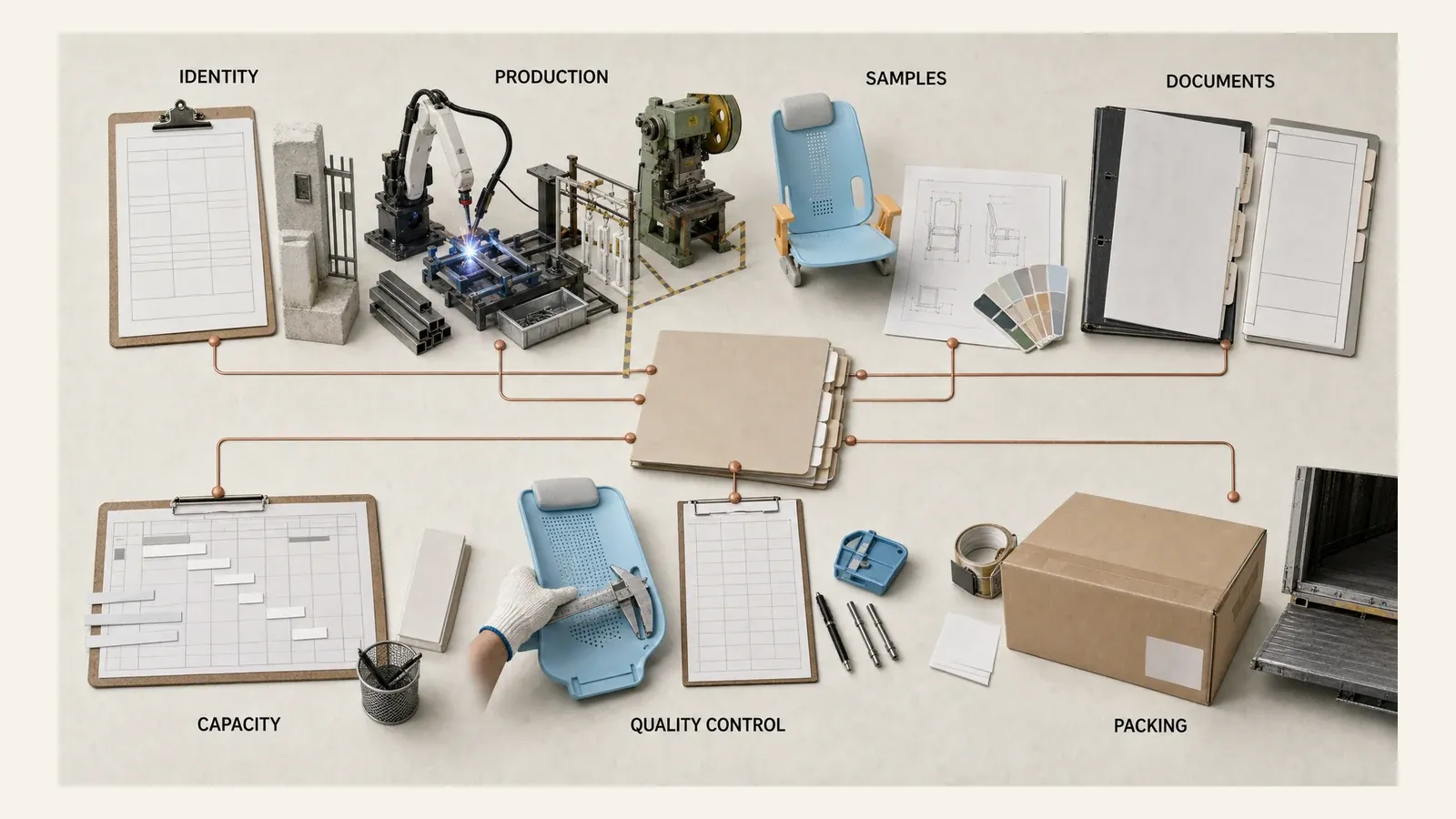
Legal identity and production address
Match the contracting company, business license, production address, export entity, quotation, invoice, and bank beneficiary. Record the relationship between the factory and any trading or export company involved in the order.
Product specialization, equipment, and outsourced processes
Inspect the production site against the quoted products. Look for the required cutting, bending, welding, panel machining, molding, coating, assembly, and packing processes. Map outsourced seats, tops, hardware, finishes, or other components together with incoming inspection points.
Comparable school projects and production records
Review projects with similar products, quantities, processes, and destination requirements. Ask the supplier to trace one comparable order from incoming materials through first-piece approval, production checks, defects, rework, final release, and packing. This shows how the factory controls an order in practice.
Materials and production-intent samples
Document dimensions, materials, components, colors, finishes, structures, labels, and packaging. Approve a representative set for each important size or configuration, then retain signed specifications, drawings, photographs, and physical references for mass production.
Testing and compliance documents
Match every document to the certificate holder, issuing body, model, configuration, sample, test method, destination market, and validity period. Build the order's evidence list around the products and user groups in the room schedule.
Capacity and current workload
Evaluate available capacity during the required production window. Review current orders using similar equipment and processes, planned batch dates, critical sub-supplier lead times, and the people responsible for the schedule.
Quality control and change management
Define inspection stages, tolerances, acceptance criteria, defect classes, deviation approval, corrective actions, and release records. Route later changes to materials, dimensions, components, finishes, or packaging through a numbered approval process.
Packaging, loading, and after-sales support
Confirm assembled or knock-down shipment, carton protection, room and SKU labels, packed dimensions, loading plans, spare parts, and closed-carton assembly checks. Also record delivery milestones, replacement-part procedures, warranty handling, and after-sales responsibilities.
Regional research finds potential suppliers. This factory evidence shows which supplier can execute the specified order.
5. How to Prepare a School Furniture RFQ
A school furniture request for quotation works best when every supplier receives the same room schedule, product specification, delivery scope, and pricing format. Public school RFPs often organize requirements by space, quantity, delivery phase, installation responsibility, supplier experience, project approach, and cost. That structure also works for international sourcing.
Include these ten sections:
- Buyer and project background: Buyer role, project or tender status, school type, target market, and supplier-selection stage.
- Room schedule and user groups: Classrooms, dormitories, libraries, laboratories, auditoriums, cafeterias, staff areas, grade levels, and relevant user groups.
- Product categories and quantities: Product references, quantity by room, color or size variants, delivery phases, spare parts, and optional items.
- Dimensions and configurations: Numeric dimensions, adjustment ranges, drawings, room layouts, accessories, assembly conditions, and reference images.
- Materials and finishes: Board, timber, steel, plastics, upholstery, colors, coatings, edge treatments, hardware, and required material records.
- Budget and pricing format: Budget range when available, currency, quotation validity, unit price, room or package price, tooling, samples, testing, freight, installation, and other service lines.
- Destination and schedule: Country, port or delivery location, Incoterm with named place, sample date, approval milestones, shipment window, delivery phases, and installation dates where applicable.
- Testing and documentation: Required product tests, material records, certificates, labels, manuals, and destination-market documents.
- Sample and approval process: Sample purpose, drawing approval, color references, change control, production references, and inspection arrangements.
- Logistics and service scope: Packaging, carton and room labels, loading, inland transport, consolidation, inside delivery, assembly, installation, waste removal, spare parts, and after-sales support.
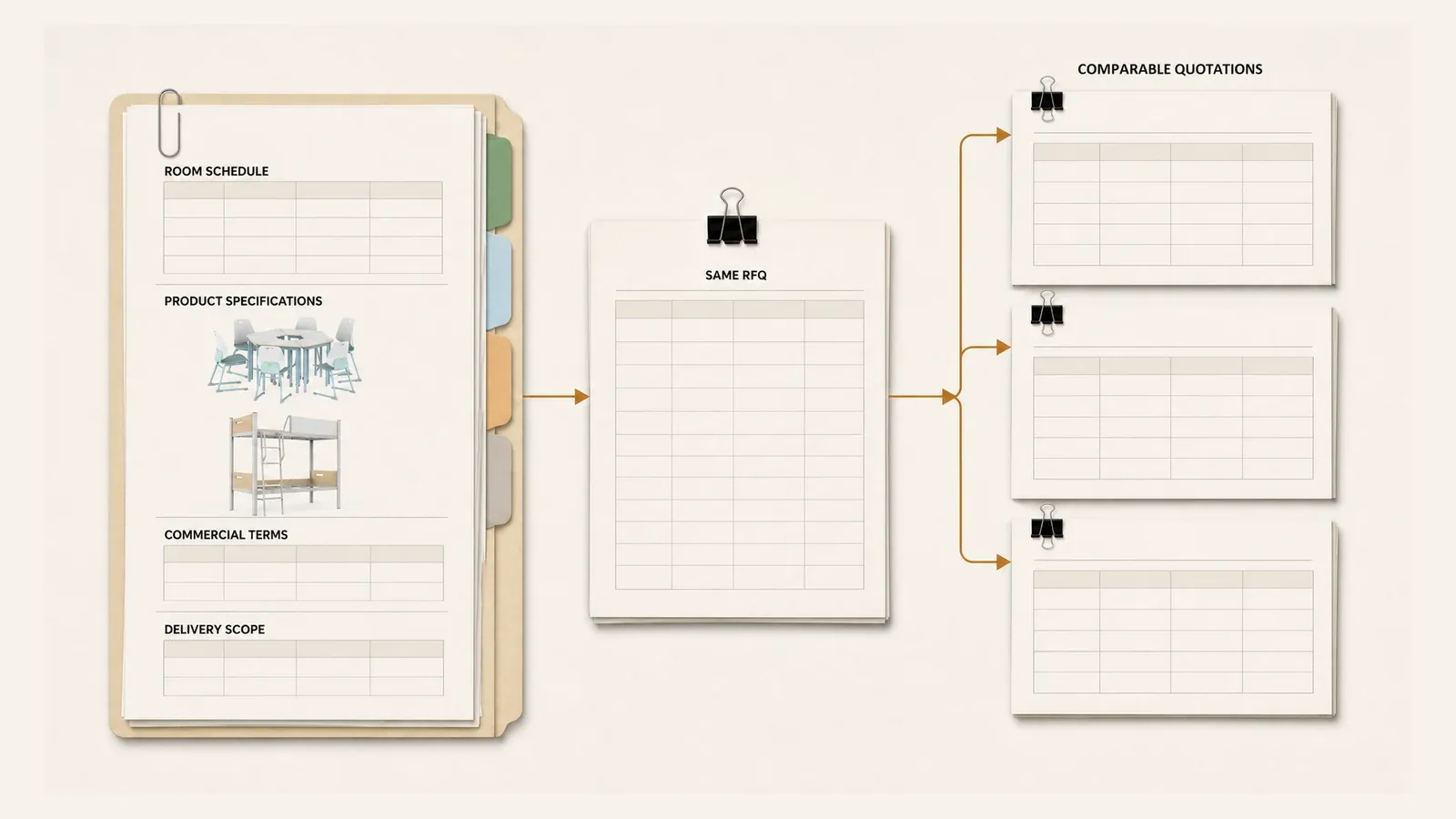
Ask each supplier to mark every line as compliant, an alternative proposal, or an open question. Require alternatives to include measurable specifications, price effects, and schedule effects. This keeps quotations aligned while allowing factories to present workable options.
Compare the complete offer: specifications, samples, documents, production dates, packaging, logistics, installation scope, commercial terms, and open assumptions. The resulting decision reflects the cost and execution plan for the whole project, rather than one unit price.
To discuss an upcoming project, send your product list, quantities, project or tender status, target market, budget, schedule, and logistics background through the Yuzhen Furniture contact page.
Conclusion: Choose the Region, Then Prove the Factory Fit
China's school furniture manufacturing network combines specialized local hubs with broader industry clusters. Nancheng leads with school-furniture concentration. Yongkang and Bazhou add metalworking and steel-furniture depth, while Chengdu supports western and mixed-category projects. The Pearl River Delta serves specialized spaces and export programs. The Yangtze River Delta contributes seating and product-development resources.
Use that map to focus the supplier search. Then compare the actual factory's processes, materials, samples, documents, current workload, quality controls, packaging, and delivery plan against one consistent RFQ.
Regional research narrows the search; factory evidence determines project fit.