
How to Calculate School Furniture Landed Cost and Compare Supplier Quotes
A practical guide to defining the cost boundary, standardizing school furniture quotations, calculating total landed cost, allocating shared charges, and comparing suppliers on the same delivery basis.
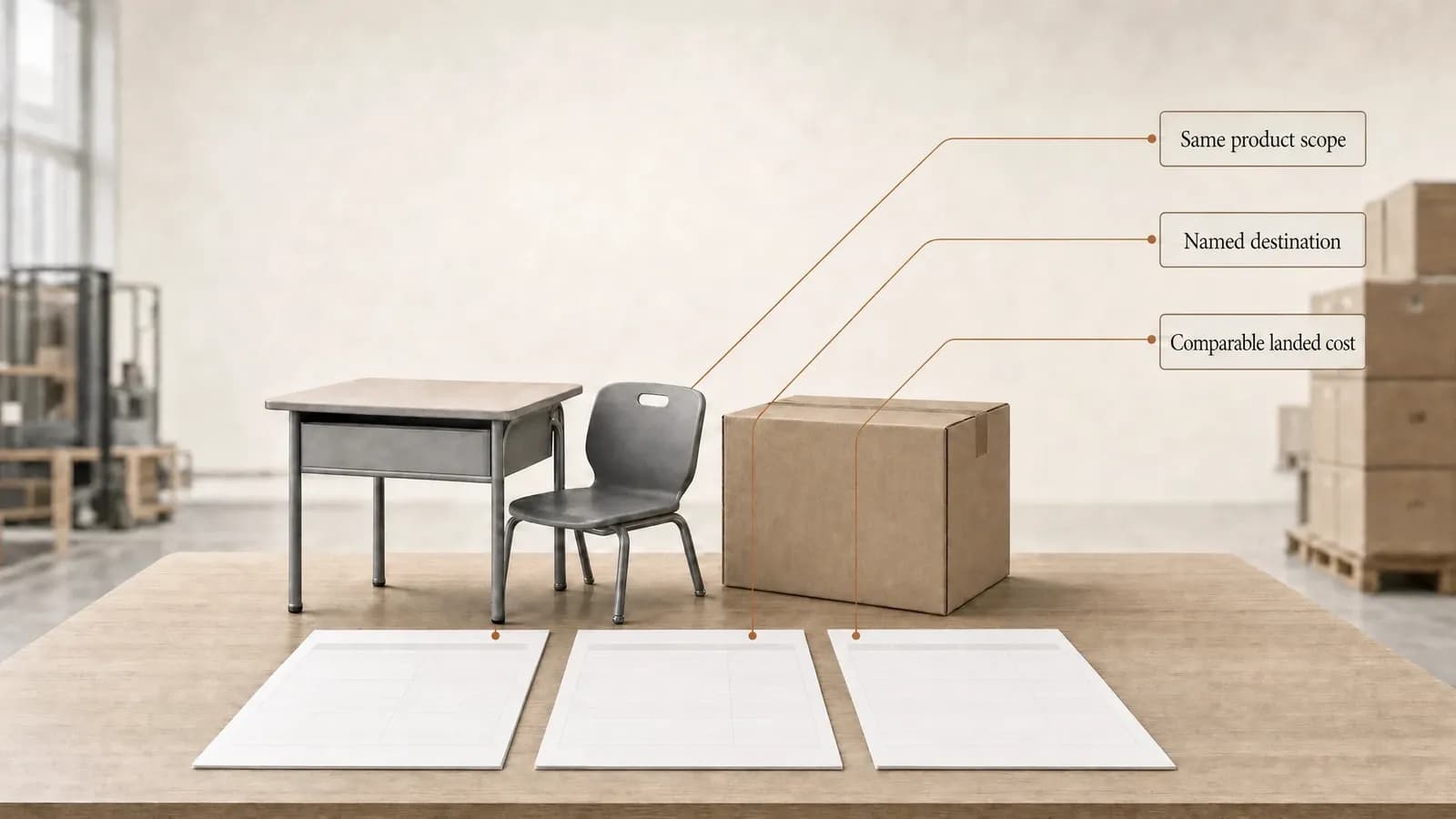
Table of Contents
Supplier A may offer a lower price for student desks and chairs, while Supplier B may quote more but include freight to a named port. A third quote may cover delivery farther inland. Comparing those product prices alone does not show which offer will cost less at the required destination. A school furniture landed cost calculation places every quotation on the same product and delivery basis, then adds the applicable costs needed to reach that endpoint.
Why School Furniture Quotes Need a Landed Cost Comparison
A supplier quotation describes the products and services included in that particular offer. Its total may stop at the factory, an export terminal, a destination port, a warehouse, or another named place. The lowest product price can therefore sit beside a wider freight or destination-service gap, while a higher quotation may already include part of that route.
An institutional buyer needs three answers before comparing the totals:
- Do the quotations cover the same furniture configuration and quantity?
- Do they reach the same named destination under the same commercial basis?
- Which transport, insurance, import, and destination costs still sit outside each quotation?
School furniture landed cost brings the quoted product price and the applicable costs of reaching an agreed endpoint into one calculation. The endpoint must be stated clearly. Delivery to a destination port, delivery to a project warehouse, and delivery with on-site installation represent different cost boundaries. Defining that boundary first gives every supplier comparison the same finish line.
This method turns a collection of product prices and service estimates into a purchasing comparison. It also keeps missing amounts visible, so a quote with incomplete freight or import inputs does not appear artificially cheaper.
What Costs Should Be Included in School Furniture Landed Cost?
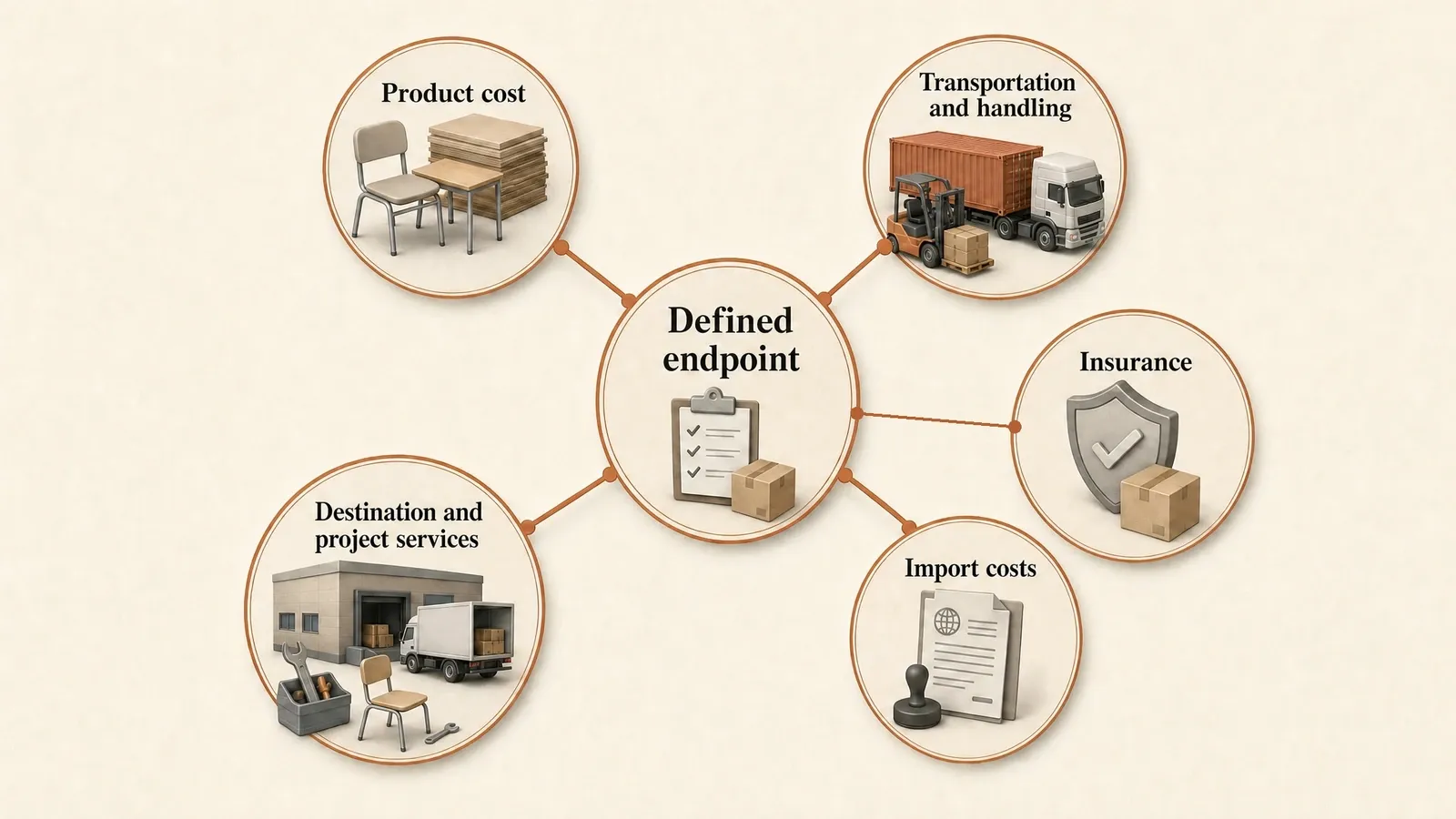
The calculation starts with five cost groups. Each group answers a practical question about what the project will pay to obtain the specified furniture at the agreed destination.
| Cost category | What it can include |
|---|---|
| Product cost | Furniture, approved configuration, quantity, packaging, and agreed assembly work in the supplier quotation |
| Transportation and handling | Collection, export handling, main carriage, terminal or port handling, and onward transport for the selected route |
| Insurance | Applicable cargo insurance, with its insured value, scope, and coverage period identified |
| Import costs | Classification and customs-value inputs, duties, taxes, entry or broker charges, and other current costs for the actual destination market |
| Destination and project services | Required receiving, inspection, storage, internal delivery, installation, packaging removal, spare parts, or other agreed services |
A useful working expression is:
School furniture landed cost = product cost + applicable delivery costs
Here, applicable delivery costs cover the transportation, insurance, import, destination, and project-service amounts required by the defined route and scope. The expanded worksheet records each category separately.
Projects use this framework selectively. A shipment does not automatically incur every item in the table, and some costs may already be included in the supplier quotation. Each amount enters the calculation only when it applies to the project and has a stated source or remains clearly marked as pending.
The cost boundary also controls the result. A landed cost to a port excludes later inland delivery unless that service has been added. A cost to a warehouse can include onward transport while leaving installation outside the total. Writing the endpoint beside the calculation prevents a port-level total from being compared with a fully delivered project total.
Standardize Supplier Quotes Before Comparing Them
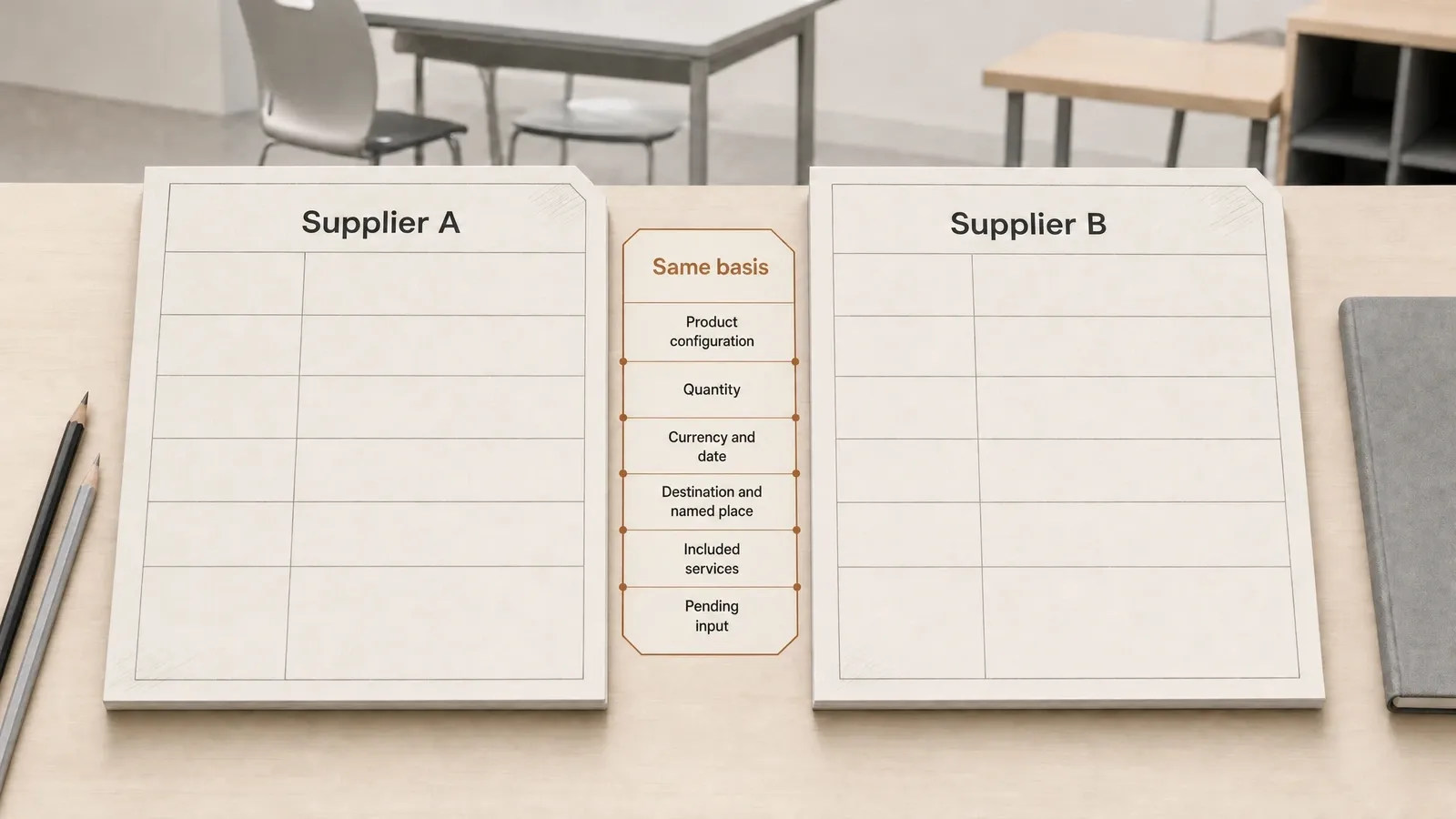
The cost calculation becomes useful after every supplier is pricing the same requirement. This step has two parts: matching the furniture scope and matching the commercial conditions.
Use the Same Product Scope
Send each supplier the same compact product schedule. For a school furniture project, it can include:
- product category, model or defined configuration;
- intended room and user group where relevant;
- dimensions, materials, finish, and accessories already specified by the project;
- quantity by product, room, or project phase;
- assembled, knock-down, or another agreed packing state;
- sample, document, inspection, and acceptance requirements already defined.
Two suppliers may both quote a student desk-and-chair set while using different desktop materials, frame structures, chair configurations, accessories, or packing methods. Those differences can change the product price, packed volume and weight, freight estimate, receiving work, and useful comparison unit. The worksheet should show the differences rather than treating the products as identical.
Use the Same Commercial Basis
Record the following information beside every quotation:
- original quotation currency;
- quotation date and validity period;
- exchange-rate source and comparison date when conversion is needed;
- precise destination used for the freight and service estimates;
- Incoterm rule, named place, and version;
- costs and services included in or excluded from the quoted amount.
Keep the supplier's original currency visible and place currency conversion on a separate line. Freight, insurance, and service estimates also need issue dates or validity periods. This keeps a current product quotation from being combined silently with an expired freight rate or an unrelated exchange rate.
Any field that still lacks a confirmed answer remains TBD / quote required. A pending freight charge, classification input, or service responsibility represents an open cost question. Keeping it visible supports the next inquiry and prevents a blank field from becoming a zero-cost assumption.
Build a Landed Cost Worksheet and Calculate the Total
The worksheet is the center of the comparison. It brings the five cost groups into one place and shows which amounts are included, where the other amounts came from, and which figures still require confirmation.
This landed cost calculation stays tied to the defined destination and matched quotation scope. The worksheet is the record that shows how each amount enters the total.
Use the following sequence for each supplier:
- Enter the supplier's product quotation for the matched configuration and quantity.
- Add the transportation and handling costs required to reach the agreed destination.
- Add cargo insurance when it applies and is not already included.
- Add the import costs supported by the destination-market review.
- Add the destination and project services included in the comparison boundary.
- Check for costs already contained in another quotation line.
- Add the applicable amounts and keep every pending input beside the result.
A compact working table can use these core fields:
| Cost category | Amount and currency | Included in supplier quote? | Source | Status | Notes |
|---|---|---|---|---|---|
| Product cost | TBD / quote required | Yes / No / TBD | Supplier quotation | Quoted / pending | Record configuration, quantity, and exclusions |
| Transportation and handling | TBD / quote required | Yes / No / TBD | Supplier or freight provider | Quoted / estimated / pending | State route stage and destination |
| Insurance | TBD / quote required | Yes / No / TBD | Supplier, insurer, or freight provider | Quoted / estimated / pending | State insured basis and coverage |
| Import costs | TBD / quote required | Yes / No / TBD | Official source and qualified provider | Verified / estimated / pending | Recheck for the actual shipment and entry date |
| Destination/project services | TBD / quote required | Yes / No / TBD | Relevant service provider | Quoted / estimated / pending | Include only services within the comparison boundary |
The detailed working file can add the pricing basis, issue date, valid-through date, allocation method, and responsible party. Those fields support review and updates, while the compact table keeps the calculation readable.
Check for Duplicate Charges
Each added line should be checked against the supplier's inclusions and the other service quotations. For example, a CIF quotation for an appropriate sea shipment includes freight and insurance to the named destination port under that rule. The worksheet should not add the same main-carriage and insurance amounts a second time. Destination charges, inland delivery, and other exclusions still need to be confirmed from the actual quotation and route; the Incoterm abbreviation alone does not provide every amount.
Use the written supplier quotation, freight estimate, insurance offer, customs input, and destination-service quotation to identify the scope of each figure. This produces a total that can be traced and updated without rebuilding the whole comparison.
Understand Incoterms and Who Pays Each Cost
Incoterms 2020 provides 11 rules for allocating delivery obligations, costs, and risks between the contracting seller and buyer. In a landed cost comparison, the rule helps explain where the supplier's quoted delivery scope ends and which route costs the buyer still needs to obtain.
Record the term in its complete form:
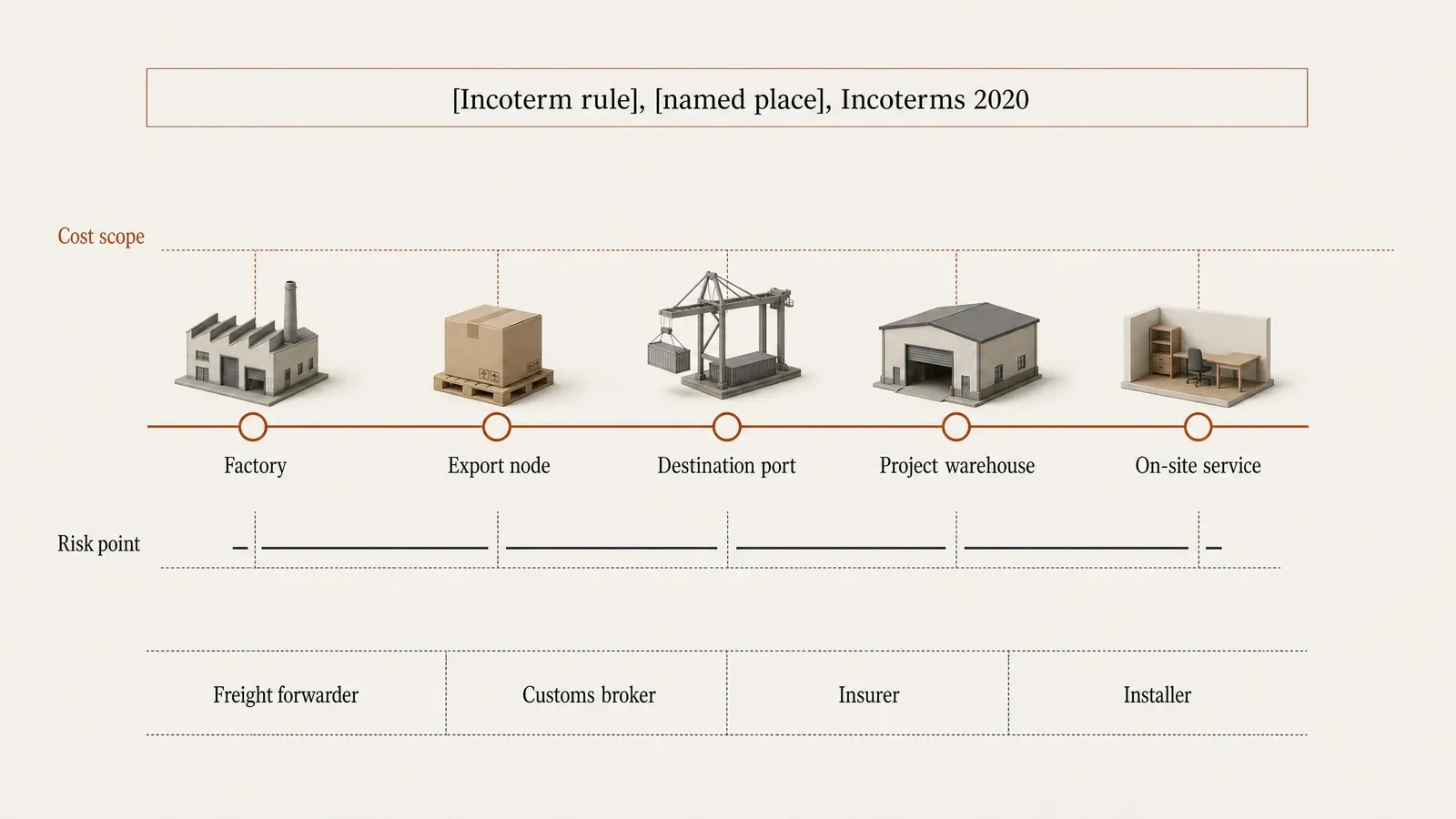
[Incoterm rule], [precise named place], Incoterms 2020
The named place identifies the location connected to delivery or transport-cost responsibility under the selected rule. The risk-transfer point may be different from the cost-transfer point, and insurance arrangements require their own review. A quotation that records only FOB, FCA, CIP, or another three-letter term leaves an important part of the delivery scope undefined.
Incoterms also has a defined role. The selected rule supports the allocation of delivery obligations, costs, and risks between the seller and buyer. The sales contract continues to govern the goods, price, payment, ownership, remedies, and other commercial terms.
Freight forwarders, customs brokers, insurers, warehouses, inspection companies, and installers work under their own quotations or appointments. For each third-party amount, record the service and route segment covered, its exclusions and assumptions, its validity period, and the party that will confirm the final scope. Their figures can enter the landed cost calculation while their responsibilities remain separate from the Incoterm between buyer and seller.
Reading the written quotation, named place, and service scopes together gives the buyer a practical responsibility map. It also makes the duplicate-charge review more reliable than assigning every cost from the three-letter rule alone.
Allocate Shared Costs and Compare Supplier Quotes
School furniture orders often combine student desks and chairs, teacher furniture, classroom storage, and other product groups in one shipment. Freight, insurance, import, receiving, or installation amounts may cover several lines at once. A consistent allocation method converts those shared charges into comparable product or unit views.
Match the allocation method to the basis of the charge:
- Quantity can support a shared charge across identical or sufficiently similar units.
- Packed weight or volume can allocate freight when the carrier prices the shipment on that basis.
- Declared or insured value can allocate charges calculated from the corresponding value.
- Actual service scope can allocate receiving, inspection, storage, or installation to the products that use the service.
One method will rarely describe every charge correctly. A freight amount based on volume should not be divided by product value merely to create a uniform worksheet. Record the chosen basis and apply the same method to each supplier comparison.
The project total remains the main budget view. A cost per set or unit becomes useful when the quotations use the same configuration and quantity definition. A cost per accepted unit can be added where the project already has a defined acceptance process and a confirmed accepted quantity. Until that denominator exists, the field remains pending.
A final comparison can be summarized as follows:
| Comparison item | Supplier A | Supplier B |
|---|---|---|
| Matched product quotation | Quoted amount | Quoted amount |
| Applicable delivery costs | Quoted / estimated / pending | Quoted / estimated / pending |
| Total landed cost | Calculated total | Calculated total |
| Cost per defined set or unit | Calculated value | Calculated value |
| Pending inputs and expiry dates | Open items | Open items |
The table supports a fair comparison when both columns use the same products, quantities, destination, currency date, responsibility scope, allocation basis, and review window. The result shows the current total and the remaining uncertainty, instead of hiding open costs inside a precise-looking number.
Taxes or charges that may be recoverable require a separate cash-flow and tax review. First show the gross amount payable in the transaction. After the buyer's actual tax or accounting treatment has been confirmed, display any recoverable amount separately to explain the difference between cash outlay and final non-recoverable cost. It should not be treated as a standard landed-cost reduction for every buyer.
Verify Import Costs and Finalize the Landed Cost
Import inputs complete the calculation for the selected destination market. Use the actual product description, composition, intended use, country of origin, transaction facts, shipment method, and expected entry date to research the current requirements. These details support the relevant commodity classification, customs valuation, duties, taxes, entry charges, and other applicable costs.
The final review should confirm:
- the classification route for the actual furniture and configuration;
- the customs-value basis used for the transaction;
- current duties, taxes, and official charges for the destination market;
- broker, entry, inspection, or other service amounts that apply to the shipment;
- the date, source, status, and validity of every import input.
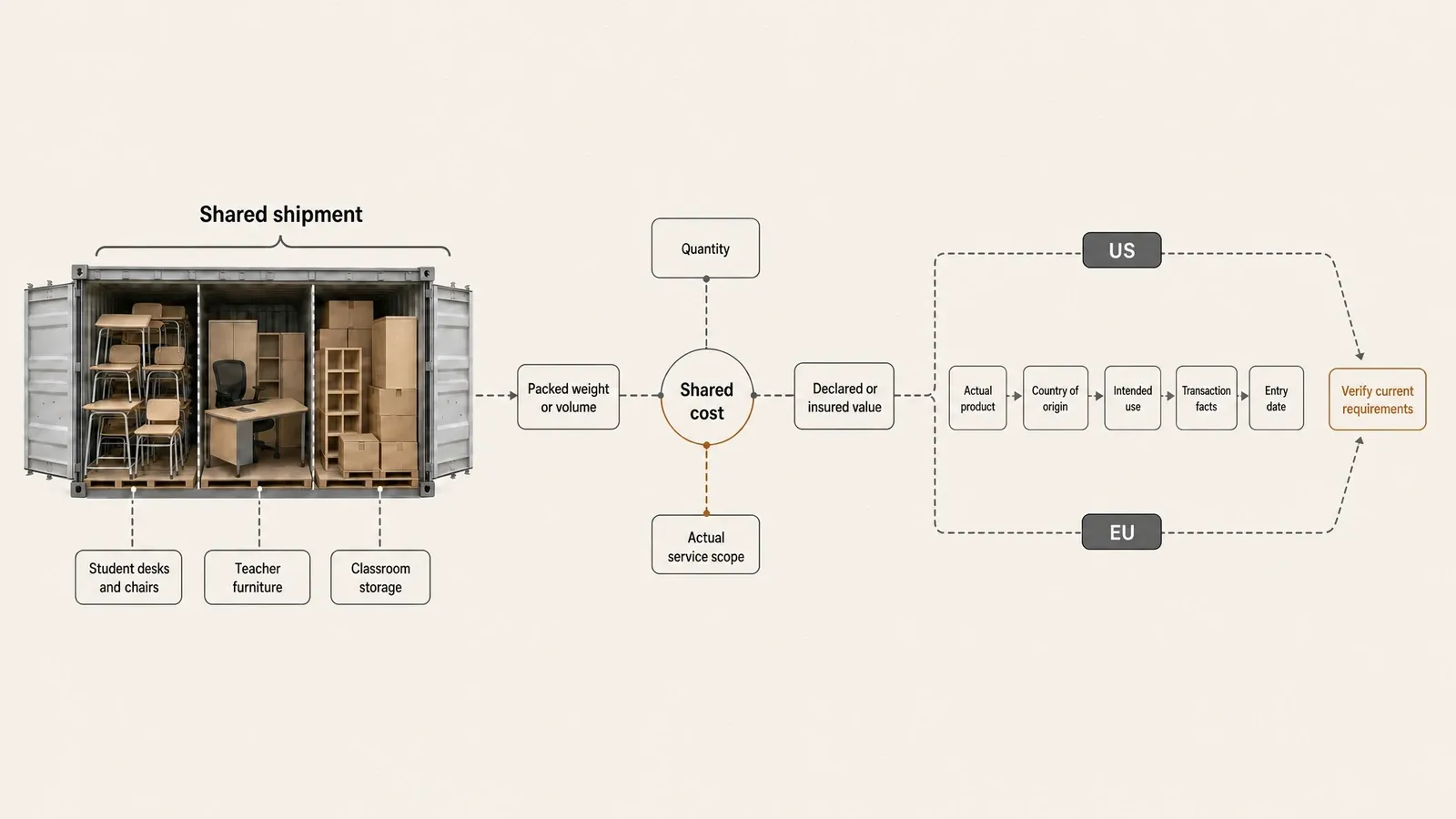
Different destination countries use different tariff schedules, tax rules, filing processes, and service arrangements. A broad furniture category or a previous shipment cannot provide a universal rate for a new school furniture order. Figures that still lack a current basis remain TBD / quote required and move into the next verification round.
For Buyers Importing School Furniture into the United States
U.S. Customs and Border Protection advises importers seeking classification guidance to provide a complete product description, country of origin and manufacturer, composition, intended use, and pricing or payment information. Use the current U.S. Harmonized Tariff Schedule to research the relevant classification for the actual merchandise.
When classification remains uncertain, CBP provides classification guidance, prior rulings through CROSS, and a binding-ruling process. A licensed customs broker can assist with entry, while the importer of record remains responsible for the accuracy of the documentation and the applicable duties, taxes, and fees. The U.S. section therefore supplies a verification path, not a single HTS code or duty rate for all school furniture.
For the wider supplier, sample, transport, customs, and receiving workflow, see the practical guide to importing school furniture from China.
After the review, turn every pending item into a specific request. Confirm the product configuration, quantity, packing information, target market, required schedule, named destination, requested evidence, and logistics context. Yuzhen Furniture can review these project inputs when discussing a school furniture inquiry. Share the project or tender stage, product category, quantity, budget, target market, schedule, and logistics background through the contact page so the selected products, quotation scope, and order-specific records can be confirmed for that inquiry.
A useful school furniture landed cost comparison begins with matched products, follows a defined delivery endpoint, and preserves the source of every amount. That structure lets the buyer calculate the current total, identify the costs still open, and compare supplier quotations on the same purchasing basis.
Frequently Asked Questions
What costs should be included in school furniture landed cost?
School furniture landed cost can include the quoted product cost, applicable transportation and handling, insurance, import inputs, and destination or project services required to reach the defined endpoint. Record the scope of each amount and keep costs already included in the supplier quotation out of the total a second time.
How can buyers compare school furniture quotes with different Incoterms?
Use the same product configuration, quantity, currency basis, destination, named place, Incoterm version, included services, and review window for every quote. Then add the route and destination costs that remain outside each quotation, record the responsibility of each third party, and check for duplicate charges.
How should shared freight be allocated across school furniture products?
Use the cost driver that reflects the charge: quantity for comparable units, packed weight or volume for freight priced on physical space, declared or insured value for value-based charges, and actual service scope for receiving, inspection, storage, or installation. Record the basis and apply it consistently to each supplier comparison.
What should a U.S. buyer verify before calculating landed cost for school furniture?
Verify the actual product description, composition, intended use, country of origin, transaction facts, shipment method, expected entry date, and current destination requirements. For a U.S. entry, use those facts to review the HTS classification, customs-value input, duties, taxes, and applicable fees through the current official sources or qualified import professionals.
Method references: DOSS landed cost glossary, Findchips quoted price vs. landed cost, DHL landed cost guide, FedEx landed cost guide, ICC Incoterms 2020, DHL Incoterms explained, CBP tips for new importers, and USITC HTS.