
Importing School Furniture from China: A Practical Guide for Institutional Buyers
A practical workflow for finding school furniture suppliers in China, comparing specifications, approving samples, checking destination-market requirements, and preparing shipping documents.
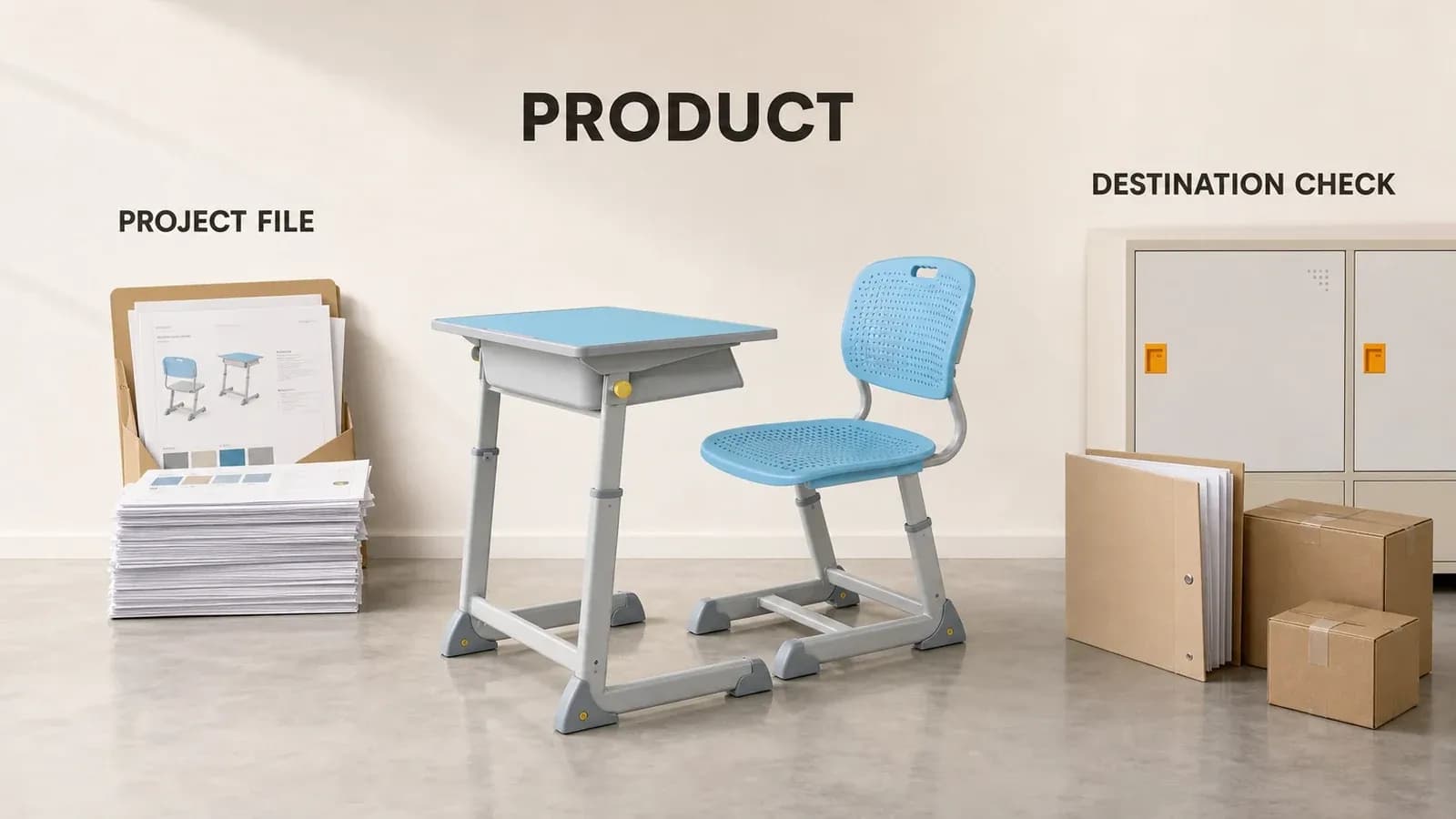
Table of Contents
Importing school furniture from China involves more than finding a factory and requesting a price. Institutional buyers need a clear project brief, comparable product specifications, sample and quality records, destination-market checks, and shipping documents that keep responsibility visible. This guide follows that workflow from supplier research to receiving the order.
Why Institutions Source School Furniture from China
Institutional buyers source school furniture from China for four practical reasons: lower factory pricing, a wider choice of price levels, broad product variety, and access to better materials, construction, or finishes when the specification and supplier tier are selected carefully. A buyer can compare basic classroom sets, adjustable desks and chairs, nap furniture, lockers, dormitory products, and modular learning furniture within the same sourcing market instead of building a separate supply route for every category.
These advantages become useful when the buyer defines what each price level includes. A low quote may cover a simpler material, finish, accessory set, or package, while a higher quote may add stronger construction, more functional options, a different finish, tighter documentation, or a more complete inspection and packing scope. Quality therefore comes from the chosen specification, sample, supplier capability, and production control—not from the country of origin alone.
Yuzhen Furniture is positioned in the mid-range campus-furniture segment rather than the lowest-price tier. Its role in this guide is to offer a campus-focused option for buyers seeking a balance among price, product choice, and verified configuration. The exact price and quality comparison still belongs to the selected model, BOM, sample, quotation, and order record.
A new campus may need desks and chairs for several age groups, while a renovation project may combine classroom seating, nap furniture, storage, dormitory furniture, or modular learning areas. Record the user group, headcount, room type, activities, approximate quantities, target country or port, required date, budget context, approval route, and document needs before requesting quotes. The Jade Ant furniture import guide follows the same practical sequence from market needs through supplier research, quotes, samples, payment, shipping, customs, and receiving.
Research School Furniture Suppliers and Verify Their Evidence
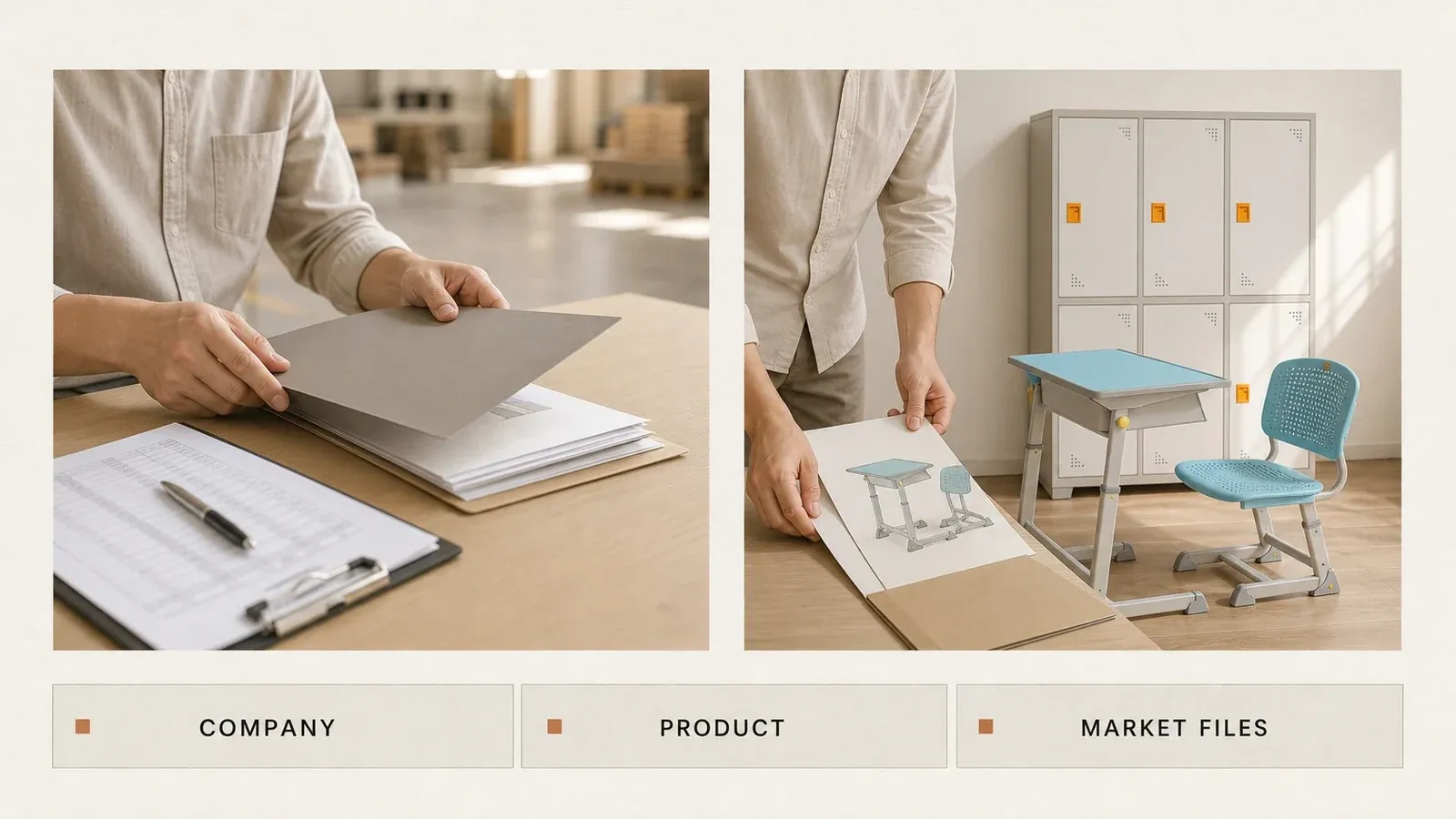
For teams preparing to import school furniture from China, supplier research can start through three routes: B2B platforms such as Alibaba, Made-in-China, and Global Sources; direct manufacturer websites and category pages; and industry contacts developed through trade fairs, project referrals, or sourcing partners. These routes create a longlist. The shortlist comes from checking which candidates can connect a legal business entity and a genuine supply role to the school-furniture category, model, sample, and documents required by the project.
Identify the project and market requirements
Before contacting suppliers, prepare a written sourcing specification. State the buyer role, project or tender stage, intended users, rooms and activities, product categories, approximate quantities, target price level, target country, destination or port, schedule, logistics context, and required product or market documents. Add dimensional drawings, material preferences, finish references, and functional requirements where the project already knows them.
This specification gives every supplier the same brief. It also keeps a search for school furniture sourcing from China focused on relevant manufacturers rather than general furniture listings. The supplier should be able to respond to the actual room, user group, quantity, configuration, and destination instead of proposing a product from a photograph alone.
Find suppliers through relevant product and company pages
Use platform filters, category searches, and trade-show exhibitor lists to find suppliers that already show the required product family. On the supplier's own website, check whether the company describes itself as a manufacturer, trading company, or combined operation, and whether its current catalogue and workshop activity match the school-furniture category. Ask for the registered business entity, business scope, manufacturing or supply role, requested category catalogue, current model reference, and a contact who can answer technical and document questions.
Platform badges, transaction history, response records, workshop videos, factory visits, and third-party audits can all contribute to the initial screen. They answer different questions. A workshop video can show that a category is being made at a stated location; a business record can identify the legal entity; a factory visit or audit can examine operations. None of them replaces the model specification or sample.
An About or company page provides company background, while a classroom, nap, dormitory, storage, seating, or modular-classroom page shows the stated range. Keep those category claims separate from model claims: materials, dimensions, accessories, packaging, and documents still belong to the selected model and configuration. Yuzhen Furniture can enter a shortlist as a mid-range campus-furniture manufacturer when its campus furniture solutions fit the project brief; the order decision still follows the same product-level checks.
Check supplier, product, and destination-market evidence
Verify the company first, then the product. The company file should identify the registered entity, stated business scope, manufacturing or supply role, and management-system records that matter to the buyer. The product file should identify the named model, dimensions, materials, structure, finish, accessories, package, and current revision. A drawing or BOM narrows the record to one configuration; a sample approval or inspection record shows what was reviewed at a particular point in the order.
Certificates and test reports need the same scope check. Request the full document rather than a catalogue logo or summary page, then review the certificate or report number, issuing or testing body, covered product or category, sample identifier, test parameters, date, and market relevance. Where the issuer provides an online database, compare the document number and holder with that record. The buyer can then connect each document to a decision: retain the supplier, approve the model, request a change, or keep the item open for review.
The destination-market file remains separate. A U.S. import may require classification and other-agency scope checks. An EU project may require an importer to review product information, safety instructions, technical documentation, and applicable conformity documents. Put the product, model, configuration, sample, date, and destination beside each request so a general company document is not mistaken for product evidence.
Review feedback without treating it as product proof
Customer reviews, transaction history, response records, and references can reveal recurring patterns in communication, delivery, packaging, missing parts, or issue handling. Read recent comments across more than one source and turn repeated observations into interview questions: How are changes recorded? How are cartons identified? Who responds to an inspection finding? What record is used when a part is missing?
These signals help buyers decide where to investigate. The model specification, sample, full evidence documents, and order record support the purchasing decision.
Request Comparable Quotes and Confirm the Product Specification
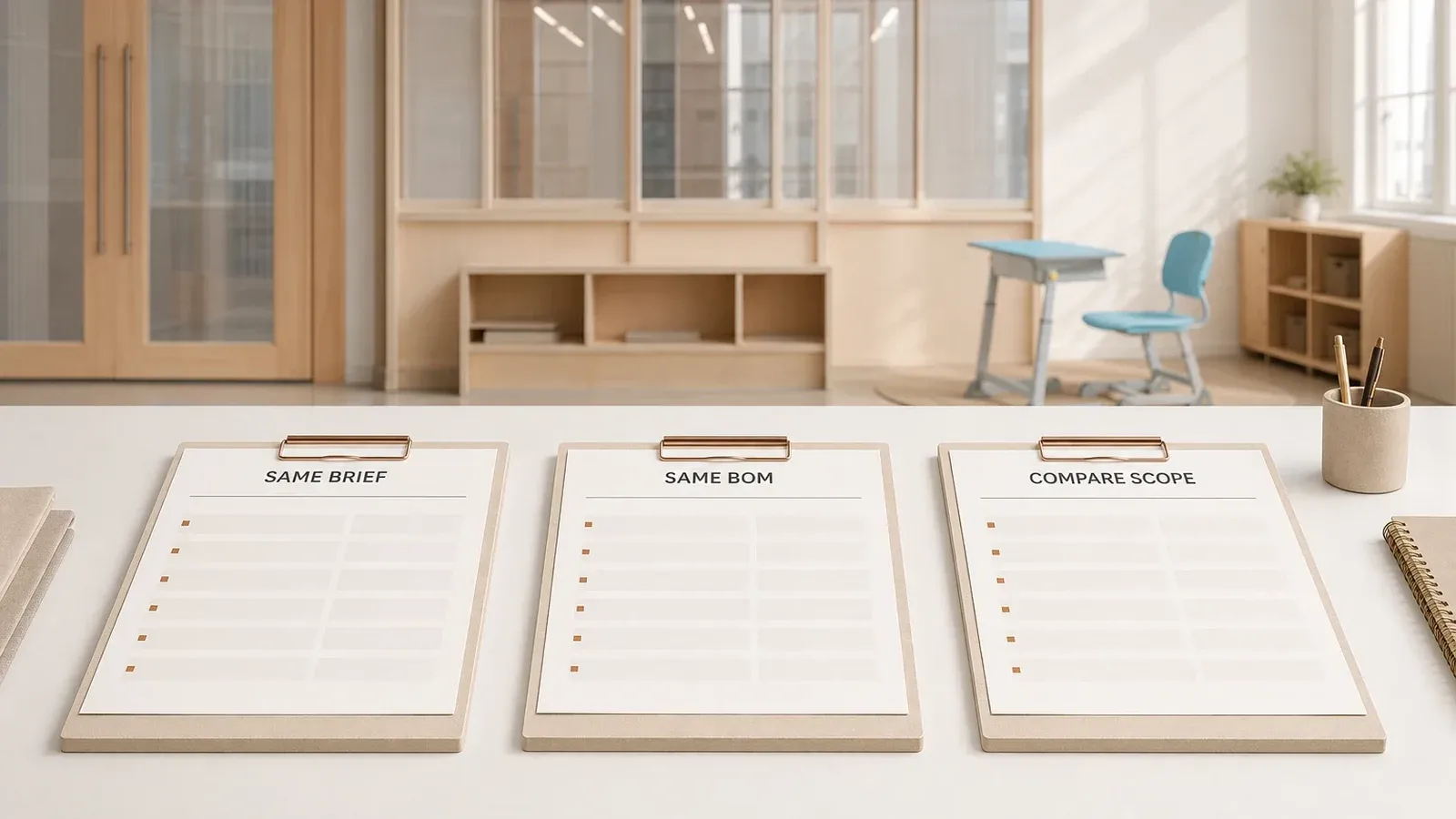
An RFQ becomes comparable when every supplier receives the same project and product questions. In this school furniture import guide, begin with the room requirement and then identify the proposed model, configuration, quantity, packaging, document needs, and commercial assumptions. Attach the same drawing, reference image, finish sample, or measurement definition to each request where those items matter. A supplier can quote clearly when the reference package leaves less room for interpretation.
Put the same product questions into every RFQ
Include:
- buyer role and project or tender stage;
- intended users, rooms, activities, and quantities;
- product category and proposed model;
- dimensions and measurement definitions;
- materials, structure, finish or color, accessories, and functional options;
- packaging, carton marks, assembly information, and spare-part expectations;
- target country, destination or port, and required product or import documents; and
- quote validity, payment assumptions, trade terms, inspection points, and open questions.
The purpose is a like-for-like comparison when a team plans to buy school furniture from China. Send the same reference package to every shortlisted supplier: the room brief, quantity schedule, dimensional drawing, finish reference, accessory list, packing expectation, and destination. A supplier can then state what it is pricing instead of filling gaps with assumptions.
When one line is much lower, compare the scope line by line before comparing the unit price. Check whether the quote excludes material substitutions, accessories, cartons, spare parts, inspection, documentation, installation, inland transport, or destination delivery. A useful comparison sheet has five columns: quoted item, included scope, excluded scope, open question, and supplier response. It turns “why is this cheaper?” into a question the supplier can answer in writing.
Match the model, configuration, and BOM
The product name alone is not enough for an institutional order. Match the model to its dimensions, materials, frame or structure, adjustment or storage features, finish, accessories, package configuration, and approved revision. Keep the same identifiers on the quotation, drawing, BOM, sample label, inspection record, packing list, and receiving checklist. This shared identifier is what allows a buyer to compare the approved sample with the item that enters the container and the item that reaches the classroom.
For example, a SY-302 adjustable student desk and chair, a TK-104 student desk, a four-door metal locker, or a backrest chair can illustrate different evidence fields. For a desk and chair, the record may need the working height, adjustment method, desktop material, frame, chair dimensions, and package contents. For a locker, it may need the number of compartments, door and lock arrangement, feet, steel treatment, finish, and packed unit. Relevant school desks and chairs and school lockers pages can organize the category discussion, while the project record confirms the exact item.
Use an example only when its model, configuration, and BOM are confirmed for the project. A model record is a reference for that item; it is not a universal import specification for every school furniture order.
Record commercial assumptions separately from product facts
Price, MOQ, payment, lead time, trade terms, inspection, packaging, installation, and delivery responsibilities belong in the commercial record. Materials, dimensions, construction, and accessories belong in the product record. Keep the quotation version beside the product specification, but do not merge the two into one unsupported statement. A price can change when the carton, accessory set, inspection point, or delivery term changes; the product itself may not have changed at all.
Ask the supplier to mark each assumption as included, excluded, or pending confirmation. This small discipline makes later negotiation easier: the buyer can revise one commercial line without silently changing the approved model.
Negotiate the order as a group of connected terms rather than a unit price alone. Compare the payment method and milestones, production schedule, inspection and acceptance arrangement, packaging level, spare parts, document set, trade term, and response to a late change or rejected item. Ask the supplier to break the schedule into approval, material preparation, production, inspection, packing, and shipment milestones. The project can then track a specific stage instead of relying on one unqualified lead-time promise.
Approve Samples and Pre-Shipment Quality Checks
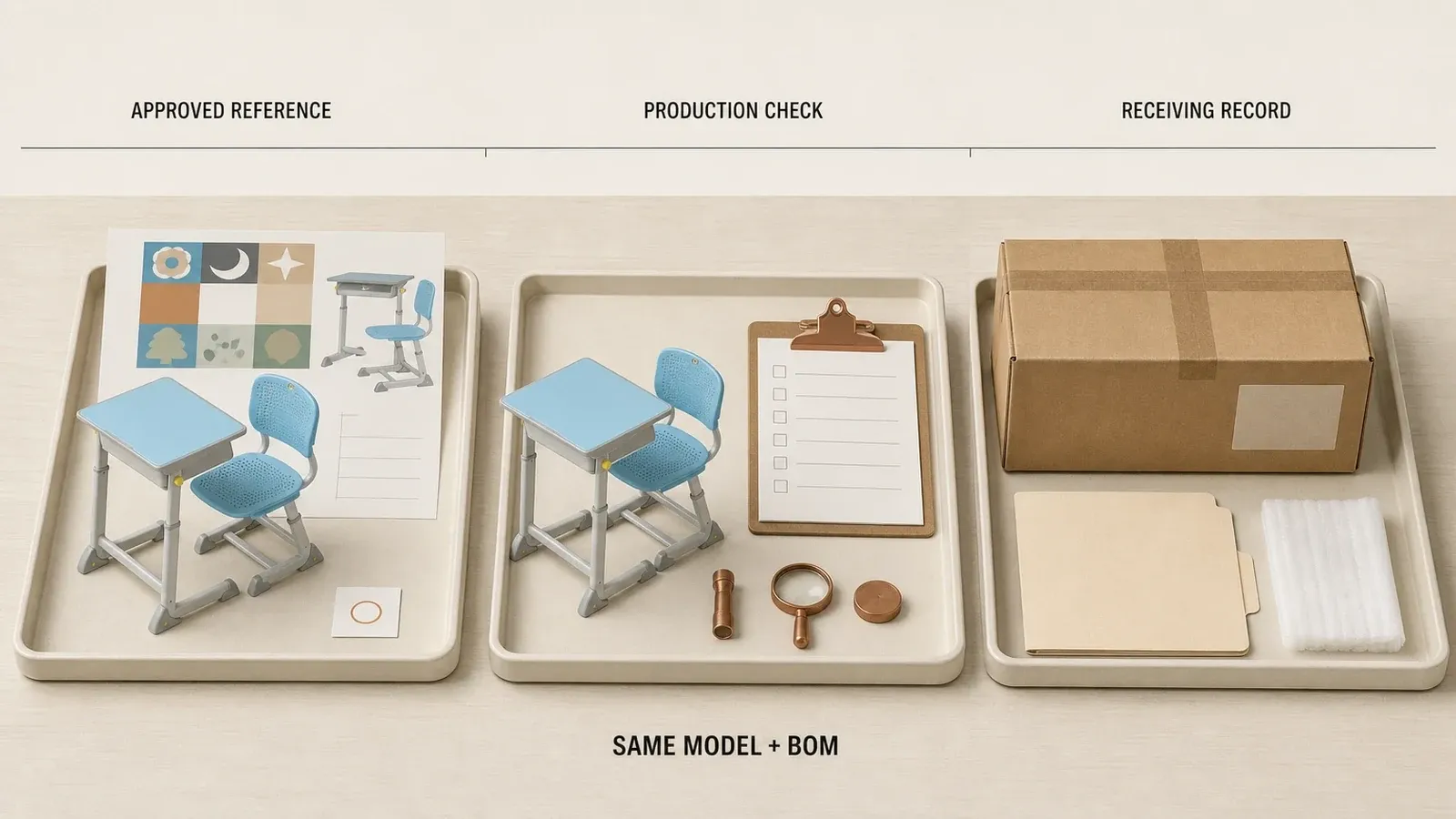
Sample approval gives the buyer a physical reference for the configuration under discussion. It also creates a useful point of comparison when drawings, production records, inspection notes, or packaging details change during the order.
Use the approved specification as the sample baseline
Review the sample against the current drawing, specification, configuration, and BOM. Ask for a production-intent sample when the order specifies a particular material, finish, hardware set, or assembly method; a showroom piece can demonstrate the idea while still differing from the item that will enter production.
Walk through the sample as a student and as a receiving team. Measure the work surface and overall dimensions, check the frame and connections, inspect welds or fasteners, operate adjustments, open storage, run a hand over contact edges, and look at finish, labels, and applicable packaging components. Separate observations into dimension, construction, function, appearance, contact or safety points, and packing. A finding such as “the adjustment works but the handle is missing” is easier to correct than a general note that the sample has “quality issues.”
Record the model, configuration, sample number, revision, measurement method, observation, photo, and decision. Label photographs with the item, view, date, and review context so the supplier and buyer are looking at the same evidence.
Record changes before mass production
A colour, accessory, material, package, or drawing change can alter the item that the buyer approved. Add the change to a revision log with the old value, new value, reason, affected model or configuration, date, and approver. Keep the previous revision visible so the team can see what changed and why. When a replacement fastener or finish is proposed, request the updated drawing or BOM before approving the change rather than relying on a message thread alone.
This record keeps the sample, the production reference, and the final product connected. It also gives the buyer a clear point to revisit when a later inspection raises a question: the team can identify the affected revision, compare the evidence, and decide whether to correct, recheck, hold, or approve the item.
Link pre-shipment checks to the approved model
Pre-shipment checks should use the same model and configuration reference as the sample and order record. The inspector can work through the same categories used at sample approval: dimensions, construction, welds or connections, fasteners, adjustment, storage, finish, contact edges, labels, quantity, carton marks, and packing completeness. The point is continuity. A check against a different revision can produce a neat report about the wrong product.
The exact inspection stage, sampling method, acceptance rule, and responsible party belong to the project. Agree those items in the order record or inspection plan. When they have not been agreed, list them as open decisions rather than presenting a generic inspection result as a guarantee. A useful checklist gives every finding an owner, an evidence reference, a status, and a next action: correct, recheck, hold, release, or claim.
An independent inspection company can provide an additional production or pre-shipment check when the buyer's risk, distance, order value, or internal process calls for it. The buyer still supplies the approved specification, defect definitions, sampling instruction, and release authority. A third-party report is most useful when it tests the same version the buyer approved.
Finalize Payment, Shipping and Import Responsibilities
Payment and shipping decisions shape the records needed for the order. Keep the purchase version, approved sample, packing information, trade terms, transport plan, and responsibility assignments together so the team can see what the shipment includes and who must confirm each step.
Confirm payment and order records
The order record should identify the current product revision, quantities, agreed options, packaging, document requirements, payment milestones, and approved changes. Store the quotation and later revisions with the same model and configuration references. Add the approved sample number, the drawing or BOM revision, and the person who approved each change. This creates one purchase version for the factory, buyer, broker, and receiving team to refer to when a question appears later.
Before a payment milestone, compare the invoice or pro forma record with that purchase version. A mismatch in quantity, accessory, finish, or package should become a written question before the payment is released. The process protects the order record without making a blanket claim about any supplier's payment terms.
Common payment routes include bank transfer, a letter of credit, and a platform payment or trade-assurance service where available. They differ in document requirements, bank or platform involvement, fees, timing, and recourse. Choose the method with the buyer's finance team and professional advisers, then write the agreed milestones and release documents into the order. A payment label by itself does not replace supplier verification or an approved purchase record.
Set packing, shipping, and trade-term assumptions
Confirm how products will be protected, labelled, counted, and identified when they leave the factory. The packing instruction should state whether items are flat-packed or assembled, what parts travel together, which surfaces need protection, and how spare parts are identified. The shipping record should show the agreed trade terms, transport route, destination or port, document set, and the party responsible for each handoff. Match carton marks and package counts to the packing list and to the model/configuration identifiers in the order record.
Furniture commonly moves by full-container load, less-than-container load, or air freight. FCL can suit a larger consolidated order; LCL can suit a smaller shipment but adds consolidation and handling points; air freight is usually reserved for samples, urgent parts, or compact high-value items. Compare the transport mode against shipment volume, urgency, handling exposure, destination facilities, and total transaction scope rather than selecting it from a generic transit-time table.
Prepare the commercial invoice, packing list, bill of lading or other transport document, carton marks, and any applicable origin, product, insurance, or destination-market documents as one shipment file. The names, quantities, values, package counts, model identifiers, and responsible parties should agree across the file before release.
Do not assume that a supplier's product page settles the shipping arrangement. The order and trade terms determine the responsibilities for the specific transaction. Write down who prepares each document, who books or receives the cargo, and who handles a discrepancy in the packing list before the shipment leaves.
Assign importer, broker, and destination responsibilities
The buyer should identify the importer or importer of record where applicable, the customs broker or other professional support, the party checking classification, and the party reviewing destination-market requirements. For U.S. entries, CBP states that an importer of record remains responsible for the correctness of entry documentation and applicable duties, taxes, and fees even when a broker is used. That responsibility should be visible in the project record rather than assumed from the fact that a broker is involved.
Yuzhen Furniture is not presented as the default customs-clearance, duty, transport, or importer-of-record party; those roles belong in the confirmed order arrangement. The same record should identify who receives customs questions, who supplies product documents, and who approves a change to the shipment documents.
Check U.S. and European Customs and Product Requirements
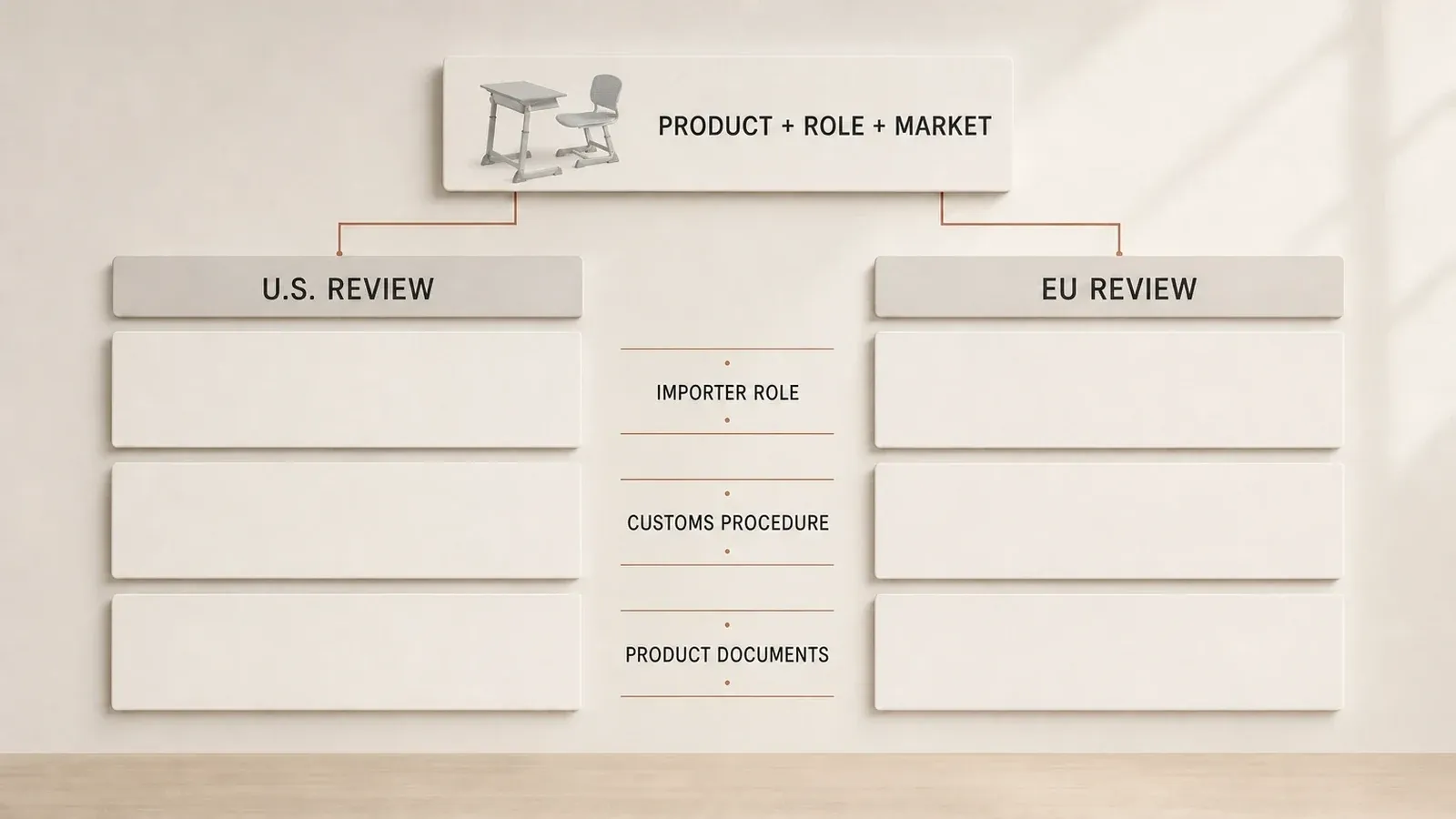
The destination market determines which import and product questions apply. The United States and the European Union should be treated as separate review paths rather than one combined rule set.
U.S. checks: entry, classification, and agency requirements
U.S. Customs and Border Protection advises new importers to consider entry type, classification, restricted merchandise, and requirements from other agencies. Start with the actual product record: what the item is, how it is made, what material and components it contains, and how it is shipped. Use the official Harmonized Tariff Schedule to research the classification that fits those facts. When the classification remains uncertain, the importer can request a written CBP ruling or use qualified customs advice; the product composition and transaction facts belong in that review.
The EPA TSCA import and export page applies to chemical substances within the scope of TSCA. It does not turn every school furniture shipment into a single TSCA certification question. Review the materials and components in the actual model, then ask whether a listed agency requirement applies to that item, shipment, and importer role.
EU checks: customs procedure, importer role, and product documentation
The European Commission's customs procedures for import and export provide entry points for customs declarations, EORI, and related procedures. Start by confirming which party is acting as the economic operator for the shipment and which destination procedure applies. Your Europe explains that an EU importer placing a non-EU product on the EU market needs to check the manufacturer's obligations, product information, safety instructions, technical documentation, and applicable conformity documentation.
Keep those files matched to the product, model, configuration, and destination market. A company certificate can describe the organization, while a technical file or conformity document needs to cover the product and rule in question. That distinction gives the importer a usable document set when a customs or market-surveillance question appears.
The exact requirements depend on the product, destination country, role, and applicable rule. A general EU workflow should not be turned into a universal tariff, CN/TARIC code, CE conclusion, or product-compliance statement for every school furniture model.
Receive, Inspect, and Record the Shipment
The import workflow finishes with a receiving record that shows what arrived. Before the truck or container reaches the receiving point, confirm the broker, carrier, receiving contact, delivery window, unloading requirements, and the documents that must travel with the shipment. The team can then inspect the cargo against the same order version used for the quote and sample.
Check carton numbers and visible damage before unpacking where the transport process requires it. Photograph torn cartons, wet packaging, missing labels, or a mismatch between carton marks and the packing list. After unpacking, record quantities, model references, configuration details, missing parts, surface or structural observations, and any difference from the approved sample, drawing, or BOM.
Keep photographs, packing records, inspection notes, and correspondence together with the order. If a difference needs review, the record should show the affected item, the evidence, the current action, and the person or party responsible for the next decision. The project can then choose a correction, reinspection, hold, release, or claim action from the facts on file. Installation, acceptance, warranty, and claims responsibilities remain those stated in the specific order and trade terms.
Common Import Mistakes and an Institutional Buyer Checklist
The most useful checklist is the one a buyer can send to every supplier and then update as the project moves forward:
- Buyer role, project stage, intended users, rooms, activities, quantities, destination country, and port.
- Product categories, exact models, dimensions, materials, structure, finish, accessories, and current BOM.
- Sample, drawing, revision, inspection point, and change-approval record.
- Packaging, carton marks, parts list, assembly information, and quantity controls.
- Commercial invoice, packing list, bill of lading or applicable transport document, trade terms, and responsibility assignments.
- U.S. or EU destination-market checks matched to the actual product, model, configuration, and importer role.
- Receiving, difference, damage, correction, reinspection, and claim records.
Common problems become easier to avoid when they are named early: choosing a supplier from a directory without checking the product evidence; comparing quotes with different assumptions; copying a dimension, material, or accessory from one model to another; approving a showroom sample that does not represent production; changing a finish or package without a revision record; leaving carton marks or document ownership unclear; and treating a search summary as a customs rule. Each mistake points back to a missing record, so the checklist is also a way to assign the next question.
Communication can prevent many of these mistakes. Use annotated drawings, marked photographs, finish references, and revision numbers for details that could be interpreted in more than one way. During production, request updates for the named order and model rather than generic factory photographs. Keep decisions from email, messaging, video calls, or inspection reports in the same change record.
Pause the shortlist review when a supplier cannot provide a verifiable business identity, avoids a live product or factory check, asks for payment that conflicts with the buyer's approved controls, offers an unusually low price without explaining the scope, or claims certificates without supplying traceable documents. These are prompts for further verification, not automatic conclusions about every supplier using the same channel.
Yuzhen Furniture can discuss the relevant campus-furniture category after a buyer provides the project role, project stage, product category, quantity, budget context, target market, schedule, and logistics information. The next discussion can then focus on the model, configuration, BOM, sample, and evidence path that the project actually needs.
Frequently Asked Questions
Where should I look for school furniture manufacturers in China?
Start with B2B platforms such as Alibaba, Made-in-China, and Global Sources, then add manufacturer websites, trade-show contacts, referrals, and sourcing partners. Use those channels to build a longlist, then verify the legal entity, supply role, school-furniture category, named models, samples, quality records, and destination-market evidence.
What should be included in a school furniture import BOM?
Record the exact model, dimensions, materials, structure, finish or color, accessories, packaging, quantity, revision, and approved sample or drawing. Keep the BOM attached to the configuration and destination-market requirements it covers.
How should I approve samples before importing school furniture?
Use the same specification, drawing, model, configuration, and BOM for the sample review and the later production check. Record changes before mass production and keep any pre-shipment inspection tied to the approved item.
What should a U.S. buyer check before importing school furniture from China?
Check the entry type, classification, restricted-merchandise and other-agency questions in the CBP guidance, then use the official HTS tool for the actual product classification. Product-specific chemical or agency requirements need a separate scope review.
What should an EU importer check before buying school furniture from China?
Check the destination customs procedure and economic-operator requirements, then confirm the importer role, product information, safety instructions, technical documentation, and any applicable conformity documents for the product and market.
Which shipping and customs documents should be confirmed before release?
Confirm the trade terms, commercial invoice, packing list, transport document, carton marks, importer or broker details, and any product or destination-market documents required for the specific shipment. Match each document to the model, configuration, quantity, and responsibility it covers.
---
For a school furniture import project, contact Yuzhen Furniture with the project role, product categories, quantities, target market, and configuration questions so the next review can stay focused on the relevant products and evidence.