
School Furniture Procurement Guide: From Project Brief to Supplier Evaluation
Plan institutional school furniture procurement from the room brief and measurable specifications through supplier evaluation, samples, total cost, delivery, and handover.
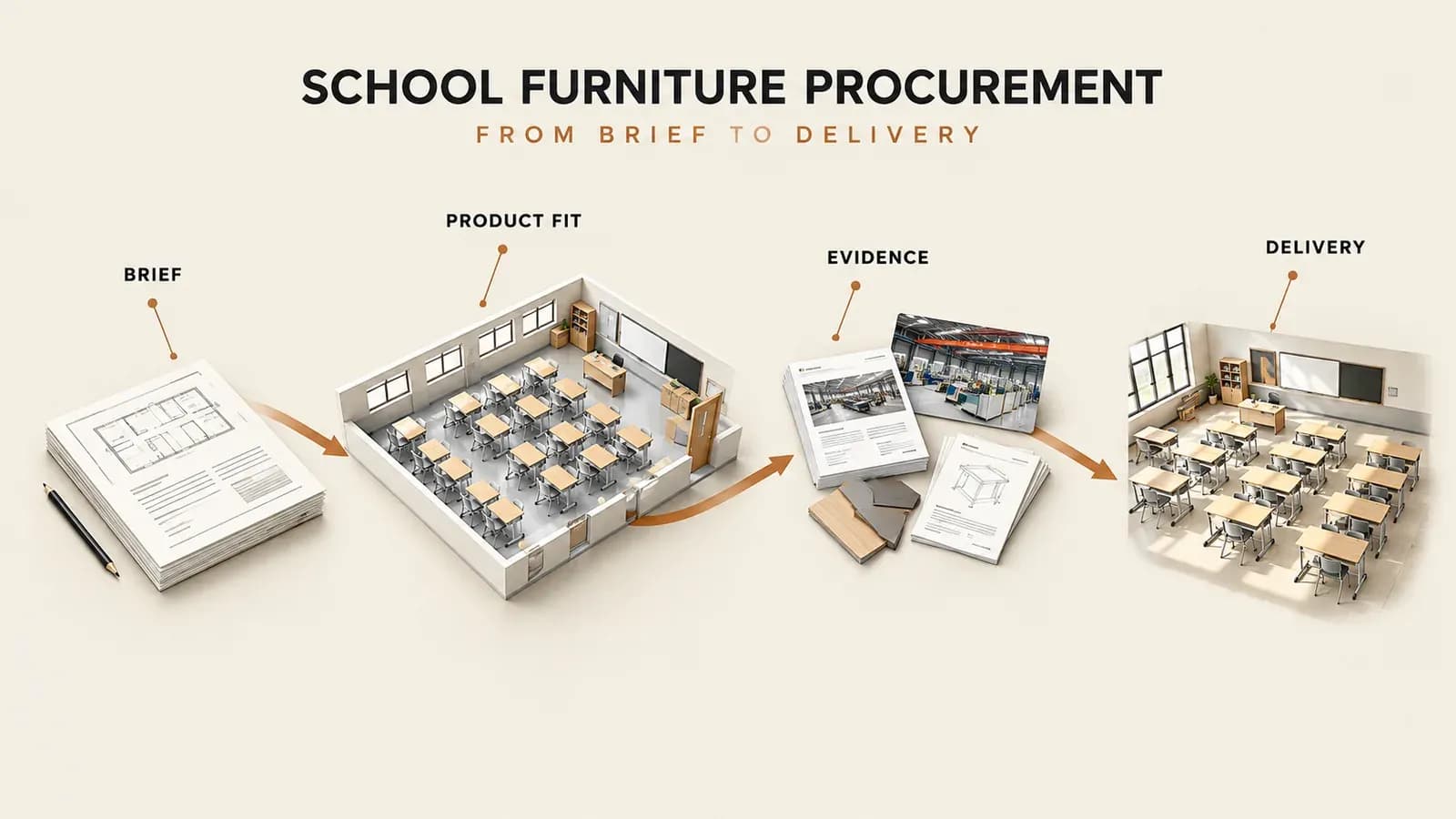
Table of Contents
A school furniture procurement guide for institutions has to cover more than comparing desks, chairs, and quoted prices. A reliable supplier turns a complete school brief into suitable products, measurable specifications, relevant evidence, repeatable production, and a delivery plan that works before opening day. The procurement process must also cover quantity changes, sample corrections, and damaged items at handover.
The difficult part is rarely finding a catalogue. It is finding out whether the supplier can carry the school's requirements through design, production, logistics, installation, and daily use without losing important details along the way.
Start with a Complete Project Brief
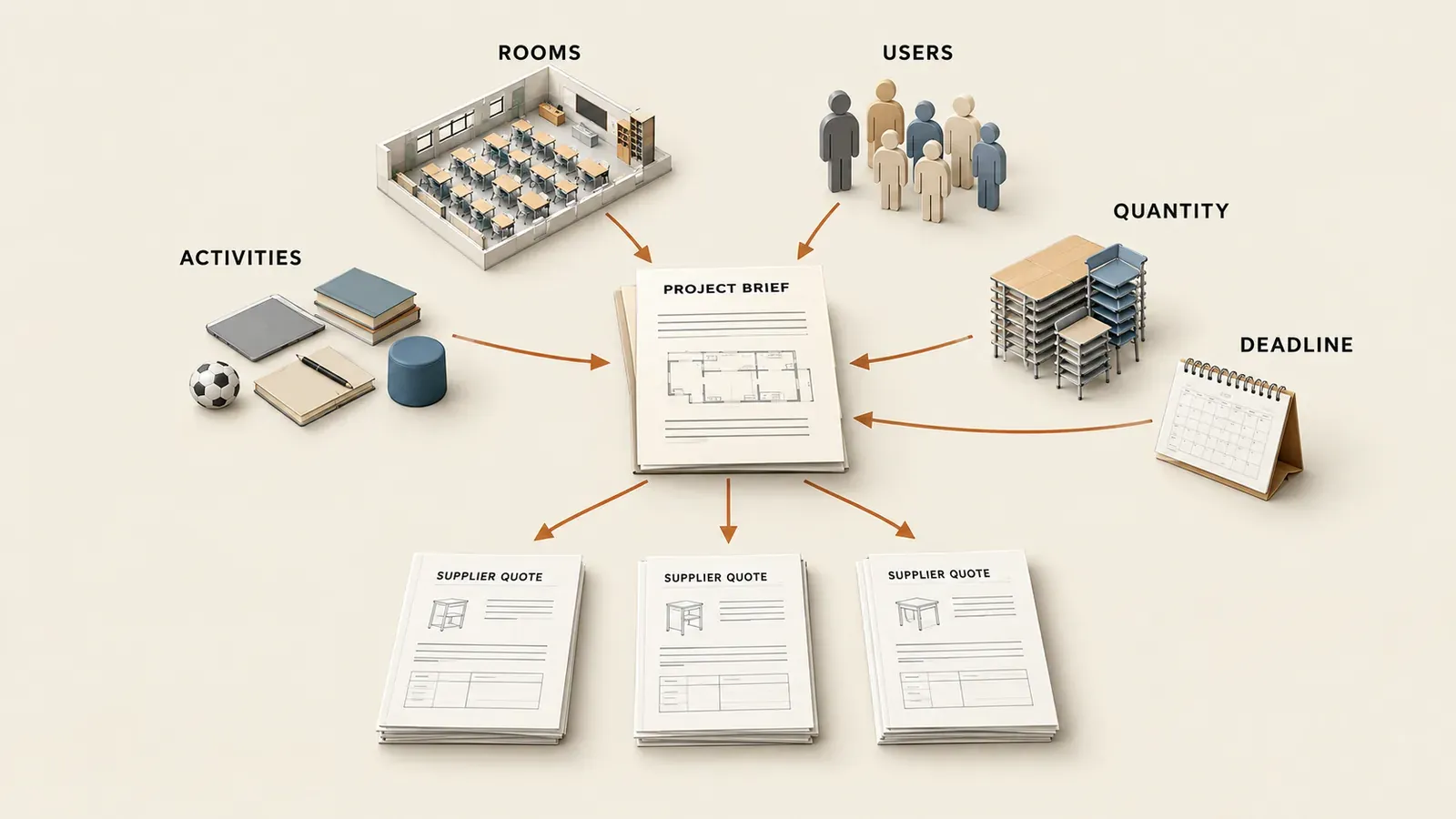
Consider a project with twenty classrooms, two nap rooms, a library, staff areas, and student storage. A request that says only "school desks and chairs, 600 sets" leaves every bidder free to assume a different size, material, finish, accessory package, delivery point, and installation scope. The resulting prices may look comparable, but they describe different projects.
The procurement team should define the school before asking suppliers to define the furniture. A room schedule is the most useful starting document. For each space, record the user group, headcount, activities, room dimensions, circulation, storage, cleaning routine, accessibility needs, and target layout. Add the destination market, budget context, approval stages, required documents, and the date the room must be ready for use.
Teachers and facilities staff usually improve this brief. Teachers notice blocked sightlines, noisy movement, bag storage problems, desks that are difficult to reconfigure, and nap furniture that takes too long to reset. Facilities teams know where hardware loosens, which joints collect dirt, what damages floors, and which replacement parts are hard to identify. Their observations turn broad terms such as "durable" or "flexible" into operating requirements.
Issue one controlled brief to every supplier. If a bidder proposes an alternative, ask it to mark the deviation instead of silently changing the basis of the quotation. This single discipline makes the rest of the evaluation far more reliable.
Match Furniture to Students and Daily Use
Furniture can satisfy a specification and still fail in the room. Product selection has to follow the student, the activity, and the way staff will manage the space.
Classroom desks and chairs
Desk and seat heights should suit the intended age or grade group and work as a pair. A seated student needs stable foot support, comfortable thigh position, clear knee space, a useful writing height, and a backrest that supports a natural posture. Good ergonomic fit helps reduce avoidable discomfort and makes it easier to maintain a settled learning position.
Early planning guides often place younger learners around 12–14 inches in seat height and move toward 16–18 inches for older students. Treat those figures as a screening range, not the final specification. Actual student stature, the desk-to-seat relationship, applicable market guidance, and a sample trial should decide the selected size.
Then use the furniture. Sit, write, stand, move the chair, shift the desk, and clean both. A stable frame should remain wobble-free under intended use. Contact edges should feel smooth. Glides should suit the floor, and movement should not turn every room change into a noisy lifting exercise. Check whether books, devices, and teaching materials fit without forcing an awkward posture.
Nap desks and chairs
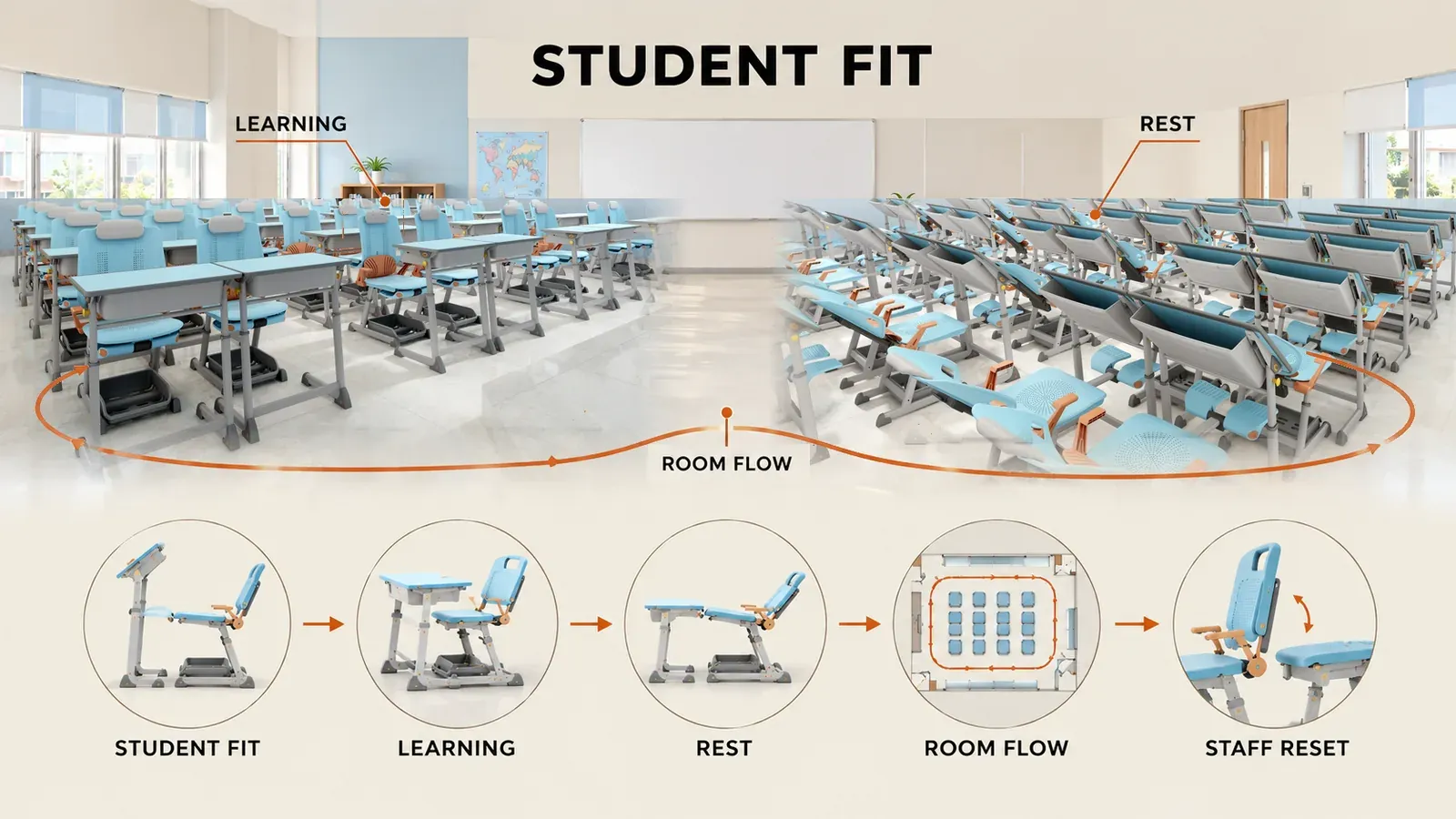
Nap furniture has two jobs, so it needs two evaluations. In learning mode, review it as classroom furniture. In rest mode, operate every conversion and lock, check stability, finger clearance, support surfaces, contact edges, and the effort required from staff.
One sample cannot show whether the room works. Lay out the planned quantity and open the furniture together. Doors, aisles, supervision routes, heating outlets, and emergency circulation must remain usable. Staff should also be able to return the room to teaching mode without complicated adjustment or loose parts.
Storage, dormitory, and flexible spaces
Storage requires the right access height, handle position, door or drawer movement, anchoring approach, and internal layout for the intended users. Dormitory furniture adds circulation, assembly, guarding, cleaning, and maintenance access. Flexible rooms need casters, brakes, nesting or stacking, turning space, noise control, and clear teacher sightlines.
Yuzhen Furniture was founded in 1991, and its campus furniture range covers classroom, nap, dormitory, storage, seating, and modular classroom applications. For a multi-space project, that range provides a practical category map before the team narrows the brief to individual models and room layouts.
Turn Product Expectations into Measurable Specifications
Words such as safe, strong, ergonomic, and high quality are useful goals, but suppliers cannot manufacture or inspect an adjective. The RFQ has to translate each goal into something visible or measurable.
For a desk, that may mean overall dimensions, worktop height, usable surface area, panel construction and thickness, edge treatment, frame section, tube wall thickness, connection method, coating system, colour reference, glides, bag hooks, fasteners, labels, and packaging. A chair specification may add seat height, seat and back dimensions, shell material, frame geometry, stacking limit, floor contact, and handhold details.
Institutional buying guides often use an 18 mm desktop, 25×25 mm or 30×30 mm steel tube, and a 60–80 μm powder-coat layer as practical reference points for certain fixed school desk designs. These figures are useful because they force a clear conversation about duty and construction. They are not universal minimums: a different span, frame geometry, material grade, joint design, or corrosion environment can justify another specification.
The same principle applies to safety details. Instead of requesting "rounded corners," define which student-contact edges need a radius or protective treatment. Instead of "easy to clean," identify the cleaning method, chemicals if relevant, exposed joints, textured surfaces, and replaceable components. Instead of "absolute stability," state the intended use, adjustment position, floor condition, and stability or strength evidence required.
A sound specification also identifies what may vary. Put colours, laminate references, accessories, labels, carton marks, and room codes in controlled fields. The clearer these details are before sampling, the lower the risk of discovering a visual or functional mismatch after hundreds of units have been packed.
Check Safety, Testing, and Tender Documents
Documentation should answer a purchasing question. A large file package is not useful if nobody can connect it to the quoted furniture and destination market.
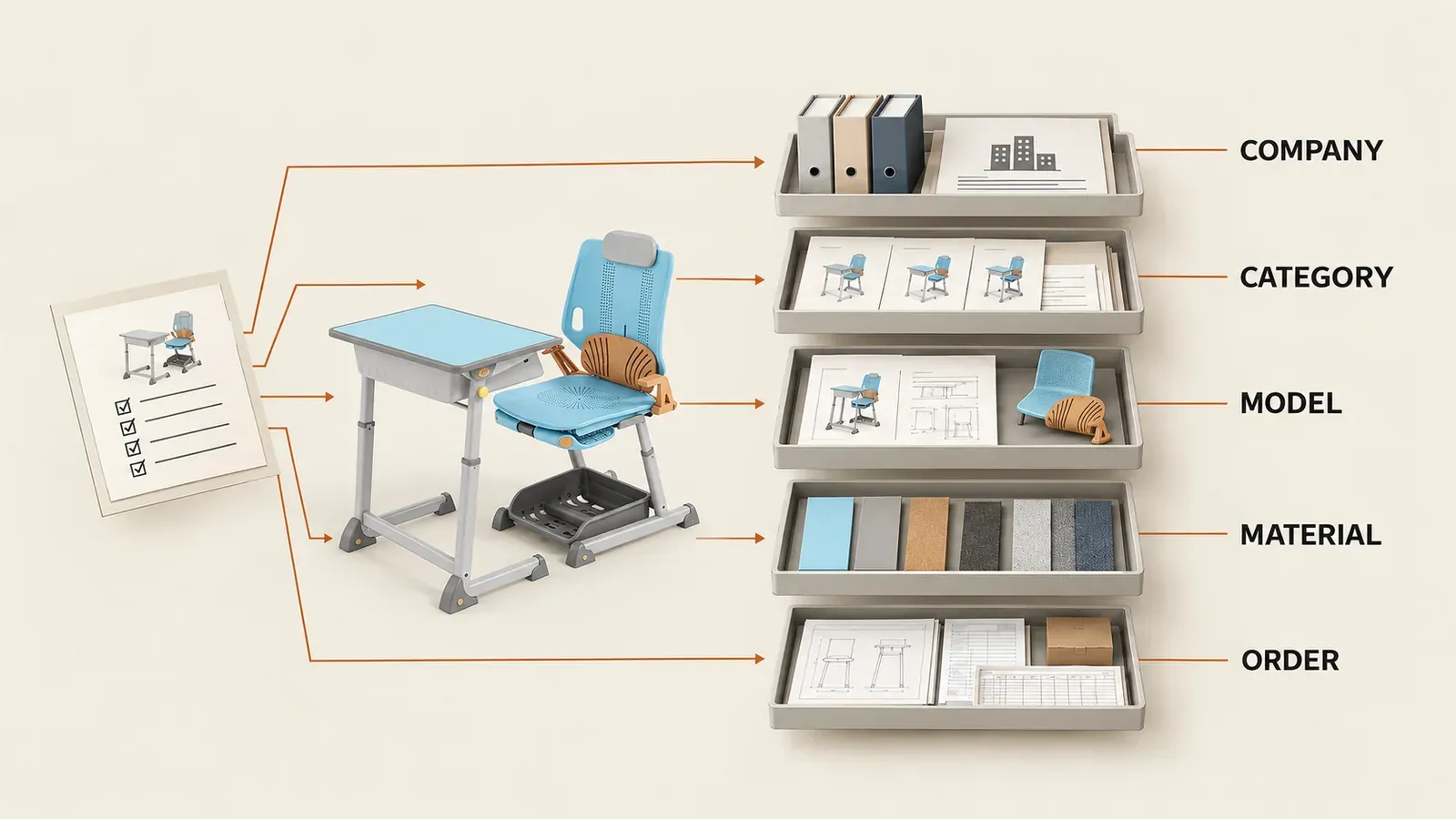
Build the tender file in layers:
- Company systems: management-system certificates help the buyer understand how the organization manages quality, environmental responsibilities, or occupational health and safety.
- Product or category evidence: certificates and declarations may apply to a defined furniture category, construction, material, or program.
- Model or sample reports: test reports identify the item, sample configuration, method, result, date, and laboratory.
- Material records: panel, coating, fabric, foam, hardware, or chemical documentation supports a specific material claim.
- Order controls: approved drawings, samples, inspection records, packing lists, and schedules connect the evidence to the purchase.
The destination market determines which layers matter. For a U.S. project, the CPSC children's product guidance helps the buyer determine whether an item falls within children's product requirements. Upholstered components may also require a separate review under the Flammable Fabrics Act guidance. Product classification comes before the document request.
For each important claim, compare the certificate or report holder, product name, model, sample description, materials, configuration, test method, date, attachments, and market with the quotation. The BIFMA education-facilities guidance is useful because it organizes standards around furniture categories and applications. The practical habit is to start with the quoted product and intended claim, then locate the record that answers it.
Assess the Manufacturer Behind the Quotation
A polished proposal can come from a manufacturer, a trading company, a distributor, or a project contractor. Any of those arrangements can work, but the buyer needs to know who controls production, who owns the documents, who approves changes, and who is responsible when the goods do not match.
Start with the legal entity and supply role. Then move to the capacity available for the required window. A factory may publish an impressive annual figure while its relevant line is already committed during the school holiday season. Ask for the planned line, shift pattern, current queue, material lead time, order start condition, and weekly or monthly output for the quoted products.
MOQ belongs in the same discussion. For example, a supplier working around 200 units per SKU may price a 50-unit pilot differently or combine it with a later production run. That does not make the supplier unsuitable. It reveals whether the commercial model matches the project's mix of trial rooms, multiple sizes, colours, and repeat quantities.
A focused factory review follows the product through the plant:
- incoming material identification and inspection;
- drawing revision and work-instruction control;
- cutting, forming, welding, drilling, edging, coating, or assembly checks relevant to the design;
- treatment of nonconforming parts and rework;
- in-process and final inspection records;
- approved-sample storage and batch traceability;
- packaging checks and room or shipment labels; and
- access for the buyer or an independent pre-shipment inspector.
ISO's certification guidance explains why buyers should look at the certification body, covered activities, sites, and current status. Yuzhen Furniture operates ISO 9001, ISO 14001, and ISO 45001 management systems. Its factory and management information gives procurement teams a structured starting point for discussing company processes before the audit moves to the selected products, production plan, and inspection records.
Use Samples to Control Customization and Batch Consistency
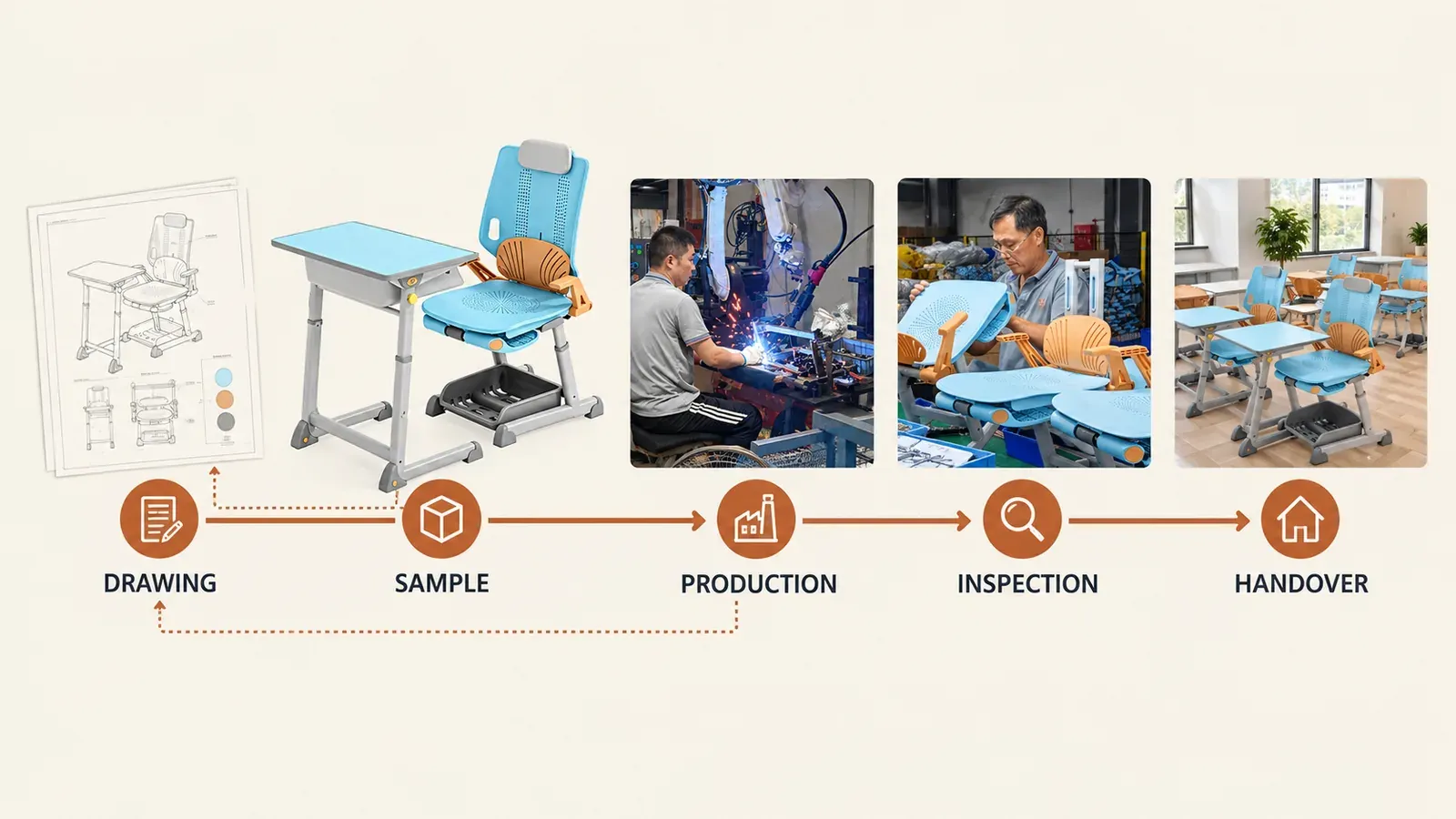
The best time to control a bulk order is before bulk production begins. A pre-production sample turns the written specification into a physical reference that procurement, design, sales, production, and inspection teams can all understand.
The control path should be simple:
- The RFQ defines the required function, dimensions, materials, finish, accessories, documents, and packaging.
- The supplier issues a drawing and configuration record that answers those requirements.
- The sample is checked through intended use, not only photographed.
- Corrections and open points are recorded, completed, and approved.
- The signed record becomes the baseline for production and inspection.
The approval sheet should identify the model, drawing revision, dimensions, material descriptions, colour or finish codes, hardware, accessories, labels, packaging, photographs where useful, approver, date, and any retained sample location. A verbal "sample approved" leaves too much room for different memories.
Yuzhen Furniture can discuss colour and selected accessory options during project review. Once the project team chooses them, the quotation, drawing, approved sample, and order schedule can carry the same configuration forward. This keeps early selection flexible without leaving production to interpret an informal request.
Batch consistency also needs a change route. When a material, component, finish, structure, or package must change, the supplier should identify the reason, affected documents, visual or functional impact, and approval needed. Controlled change is normal manufacturing practice. Invisible change is the risk.
Compare Total Project Cost on the Same Scope
Unit price becomes meaningful only after scope is aligned. Put every bid into one comparison sheet and leave missing fields visibly open.
The comparison should identify the product and configuration, quantity, materials, finish, accessories, sample cost, testing or document cost, inspection, packaging, spare parts, freight basis, delivery point, unloading, room placement, installation, waste removal, warranty, payment terms, quotation validity, assumptions, exclusions, and provisional items. A line marked "installation included" still needs a definition: assembly only is different from unloading, floor distribution, fixing, adjustment, cleaning, and room acceptance.
Then examine cost over use. A desk that needs frequent tightening, damages floors, is difficult to clean, or has no replacement glides can create more work than its purchase price suggests. For budgeting, some institutions model a 7–10 year replacement cycle for contract-grade classroom furniture. Use that as a planning scenario rather than a guaranteed life: duty, construction, student use, maintenance, environment, and replaceable parts all change the result.
The arithmetic is straightforward. Divide the installed project cost by the planning years and usable places, then add expected maintenance, replacement parts, and disruption. A higher initial price can produce a lower annualized cost, but only when the longer service assumption is supported by design, evidence, maintenance, and service access.
This is also where apparently minor exclusions surface. A low quote can lose its advantage after separate inspection fees, stronger export packaging, phased shipments, local handling, installation labour, or missing spare parts are added. Compare the whole job, not the first number on the page.
Plan Delivery Backward from the Opening Date
The school opening date is fixed more often than the factory schedule. Work backward from the day rooms must be usable, not from the day the purchase order might be issued.
An early international planning model might allow:
- 10–15 days before opening for room installation, punch-list work, and corrections;
- 5–10 days for customs clearance and local delivery where those steps apply;
- 15–25 days for sea freight on relevant routes;
- 30–60 days for bulk production, depending on quantity, configuration, materials, and factory loading; and
- additional time for drawings, sample production, review, correction, and final approval.
These allowances quickly show why a late RFQ can create zero room for recovery. Before award, replace every planning number with a milestone schedule tied to the actual project. Define what starts production: deposit, approved drawing, approved sample, confirmed material, or a combination. Name the owner and approval deadline for each dependency.
Multi-building projects need a shipment plan as well as a date. Confirm whether the order will be produced and delivered in phases, how long finished goods may be held, how cartons will be marked by building and room, and whether each phase has its own packing list and acceptance record.
The site plan should cover receiving hours, vehicle limits, unloading, temporary storage, lifts and stairs, floor protection, room distribution, assembly, packaging removal, cleaning, and security. A truck arriving on time is not project completion. The rooms must be safe, complete, correctly placed, and ready for teaching.
Define Handover, Warranty, and After-Sales Responsibility
Supplier reliability becomes visible when one classroom is short two chairs, a carton arrives crushed, a lock is missing, or an installer finds that a part does not match the drawing. Those are ordinary project events. The quality of the response depends on whether the route was defined before handover.
Create a responsibility matrix for shortages, wrong items, transport damage, installation defects, missing hardware, and warranty requests. Record the contact point, photographs and references required, response sequence, remedy options, freight and labour responsibility, and how closure will be documented. Room number, carton mark, model, batch, and part code are far more useful than a message that says "some chairs are damaged."
Maintenance information belongs in the handover package. Identify common fasteners, glides, castors, locks, panels, covers, and accessories; show which are replaceable and how to request them. A small spare-parts plan can keep a room in service while a replacement shipment is prepared.
After several weeks of use, collect comments from teachers, facilities staff, and administrators. Are student sizes working? Can staff convert a full nap room smoothly? Are mobile tables actually moving, or staying fixed because the brakes, weight, or noise make reconfiguration impractical? Early feedback supports warranty close-out and improves the next order.
Build the Shortlist and Issue a Comparable RFQ
Do not begin with a weighted score. First remove suppliers that still have a critical gap. Product fit, required evidence, approved-sample control, quotation scope, workable schedule, and a defined problem-resolution route are pass/fail conditions because strength in one area cannot erase a failure in another.
A supplier is ready for the final shortlist when it can:
- respond to the same room, user, activity, quantity, market, and schedule brief;
- describe the proposed furniture in measurable, application-relevant terms;
- connect key claims to the required company, product, sample, material, and order records;
- show how the approved sample, inspection points, traceability, and change control guide production;
- price the same commercial and service scope, with assumptions and exclusions visible;
- provide an executable milestone, logistics, installation, and acceptance plan; and
- name the route for shortages, damage, warranty, maintenance, and spare parts.
Among suppliers that pass, compare design quality, total project cost, communication, schedule resilience, service, and the priorities of the school. This prevents a polished presentation or very low price from compensating for a basic delivery risk.
The final RFQ should include buyer role, project or tender stage, room schedule, user groups, product categories, quantities, layouts, budget context, target market, required specifications, samples, documents, destination, building access, installation scope, acceptance method, opening date, and the deadline for assumptions or deviations.
Frequently Asked Questions
What information should a school include in a furniture RFQ?
Include room types, user age or grade groups, quantities, target layouts, required dimensions and finishes, destination-market requirements, budget context, sample and document needs, delivery location, building access, installation scope, acceptance steps, and the school opening date. Give every shortlisted supplier the same version.
Is a pre-production sample necessary for a bulk school furniture order?
Yes, when size, finish, function, accessories, or packaging can affect acceptance. Approve the drawing and sample together, record the exact configuration and open actions, and use that record as the production and inspection baseline rather than relying on photographs alone.
How early should schools order furniture before opening day?
Work backward from the date rooms must be usable. An early planning model may allow 30–60 days for production, 15–25 days for sea freight on relevant routes, 5–10 days for clearance and local delivery, plus 10–15 days for installation and corrections. Replace those allowances with the supplier's project schedule before award.
When should a buyer audit a school furniture factory?
Audit when order scale, customization, tender risk, or schedule exposure makes catalogue and document review insufficient. Focus the audit on the quoted products: material identification, drawing control, process checks, approved-sample storage, nonconforming product handling, final inspection, packaging, traceability, and available capacity for the delivery window.
Discuss Your School Furniture Project
Start with the Yuzhen Furniture product range to organize classroom, nap, dormitory, storage, seating, and modular applications around the room schedule. For an active project, send the buyer role, project stage, categories, quantities, budget context, target market, required timing, destination, logistics, and installation conditions through the project inquiry form.
With one complete brief, the Yuzhen Furniture team can review relevant product directions, available configuration options, sample needs, and document requirements against the same information your procurement team will use to compare suppliers.