
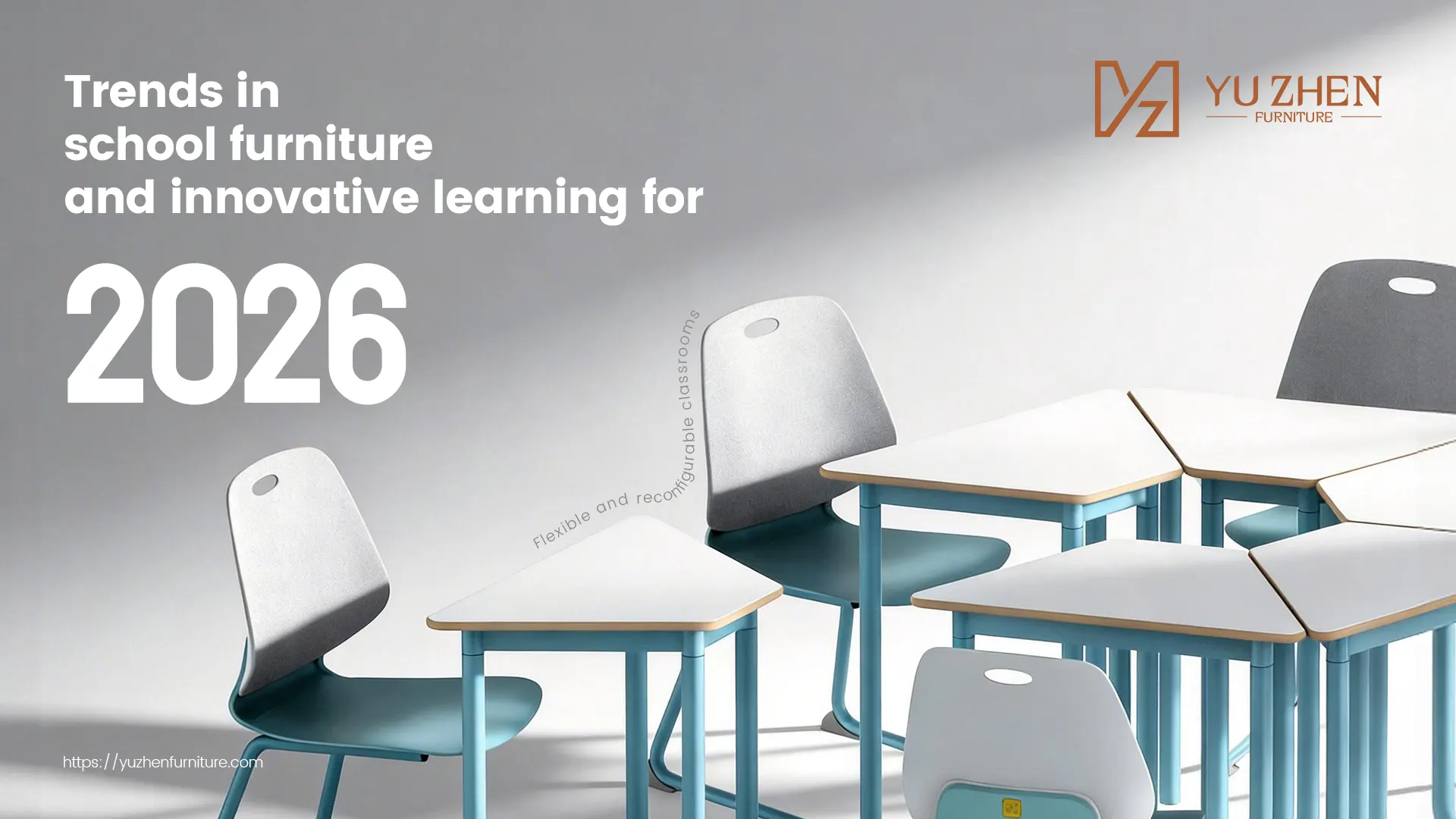
Trends in school furniture and innovative learning for 2026
By 2026, classrooms will be more flexible, teaching methods will be more sophisticated, and space design will place greater emphasis on students’ physical and mental well-being. Furniture will no longer be merely an accessory, but an essential teaching tool.
Flexible and reconfigurable classrooms

Flexibility will continue to be the central focus of new educational environments. Increasingly, classrooms that can be transformed in a matter of seconds are becoming the norm, effortlessly adapting from individual work to group activities, collaborative projects, discussion sessions or experimentation spaces.
This ability to change immediately allows the classroom to respond to the pace of teaching dynamics and encourages greater student participation.
Therefore, furniture must be lightweight, modular, or on wheels to allow for easy rearrangement without disrupting classroom instruction.In these classrooms, versatility and rapid adaptability are key to enhancing creativity, autonomy, and educational innovation.
Well-being and ergonomics as a priority
SY-302 highlights that comfort directly influences attention, participation and performance. In 2026, ergonomic chairs, Eco-friendly materials, soft curves and designs that reduce fatigue will take centre stage.
Furthermore, ergonomics will no longer focus solely on posture: it will extend to height adjustment, adaptability for different ages and body types, and the use of materials that improve acoustics and reduce sensory stress.
There will also be an increase in active rest areas, with dynamic seating that allows for controlled movement to improve concentration.
Overall, furniture is becoming an ally in promoting the physical and emotional balance of students.
Hybrid spaces: a classroom with multiple functions
The traditional classroom is evolving into a multipurpose space that can be used for presentations, debates, creativity, recording content or group work.
In 2026, this versatility will be further enhanced by furniture that allows for quick switching between activities without disrupting the classroom flow.
Adjustable desks and chairs, modular desks and chairs, desks and chairs for lunch breaks, and solutions that encourage collaborative or independent work will become essential elements.
Sustainability and durability
Sustainability is no longer a trend, but a requirement. Educational centres prioritise furniture that:
- Uses durable or recyclable materials
- Withstands intensive use
- Reduces the need for replacement
- Has responsible manufacturing processes
The combination of sustainable design and long service life will be a decisive purchasing criterion.
Furniture that drives the learning of the future
2026 is shaping up to be a decisive year in which school furniture will be more closely aligned than ever with contemporary educational needs.
Flexible spaces, student well-being, the natural integration of technology and a commitment to sustainability will be key factors in the transformation of classrooms.
These approaches not only respond to new educational methodologies, but also to a greater understanding of how the physical environment directly influences concentration, creativity, and academic performance.
Schools that choose to update their furniture will create more comfortable, dynamic and motivating learning experiences.
Classrooms that can be adapted to different activities, furniture that encourages autonomy and movement, healthier and more environmentally responsible materials, and solutions that seamlessly integrate technology will contribute to more inclusive and efficient environments.
Investing in school furniture in line with these trends not only modernises spaces, but also promotes the comprehensive development of students and strengthens the educational quality of the school.
For more information: [email protected]
Phone: +86 19868009784 (WhatsApp)